300,000 SEATS REINSTATED DESPITE ONGOING CUTS AT HIGH-COST AIRPORTS
Ryanair, Europe’s No.1 airline, today (Wed, 11 Mar) announced its Summer 2026 schedule for Germany, including the launch of 2 new airports Saarbrücken and Friedrichshafen as well as the reinstatement of 300,000 seats and 14 new routes, following the German Govt’s decision to reduce the damaging aviation tax from July 2026 and freeze ATC charges. The beneficiaries of this capacity growth are the proactive German airports who have worked with Ryanair to reduce costs such as Cologne, Niederrhein, Memmingen and Bremen airports.
This sensible policy shift allows Ryanair to reverse previously planned Summer 2026 capacity cuts. However, Ryanair’s total capacity in Germany will remain below Summer 2025 levels (-220,000 seats), as the airline continues cutting seats at Germany’s highest‑cost airports, including Berlin and Hamburg, who refuse to reduce their excessive and uncompetitive airport charges. Berlin, which remains the highest-cost airport in Ryanair’s German network, will see a reduction of 150,000 seats (-5%) and Hamburg will lose 70,000 seats (-20%). These cuts underline how excessive airport costs directly translate into lost traffic, tourism and jobs across Germany.
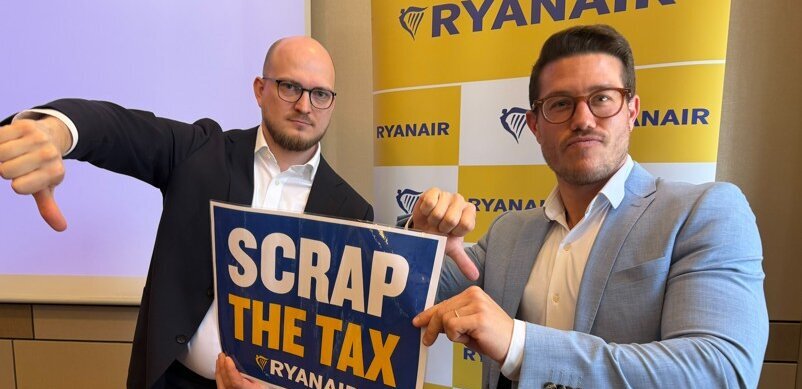
While the German Govt’s decision to cut the aviation tax and freeze ATC charges represents a welcome first step, Germany remains significantly less competitive than countries such as Sweden, Albania, Hungary, Slovakia and regional Italy, where aviation taxes have been abolished entirely. Ryanair again calls on the German Govt and Transport Minister Patrick Schnieder to fully abolish the aviation tax, halve excessive ATC and security charges and ensure competitive airport costs nationwide. If these pro-growth reforms are delivered, Ryanair stands ready to double its German traffic to 34m passengers annually, base an additional 30 aircraft in Germany (US$3bn investment), launch over 200 new routes and create over 1,000 highly paid aviation jobs.
Ryanair Head of Comms DACH, Marcel Pouchain Meyer said:
“We welcome the German Govt’s decision to cut the aviation tax and freeze ATC charges, which has enabled Ryanair to reinstate 300,000 seats and launch 14 new routes for Summer 26, delivering immediate benefits for regional connectivity, tourism and jobs. However, despite this positive first step, Ryanair’s overall capacity in Germany for Summer 2026 remains 220,000 seats lower than Summer 2025, as high-cost airports like Berlin and Hamburg continue to fail to address their highly uncompetitive charges.
Ryanair again calls on the German Govt. and Transport Minister Patrick Schnieder to scrap the aviation tax in full, cut excessive ATC and security charges by 50% and deliver competitive airport costs across Germany. If these pro‑growth reforms are implemented, Ryanair stands ready to double its German traffic to 34 million passengers annually, base 30 additional aircraft in Germany (US$3bn investment), launch over 200 new routes and create more than 1,000 high‑paid aviation jobs.
Until Germany fully abolishes its anti-growth aviation tax and tackles excessive airport, security and ATC charges, Germany will continue to lose traffic, tourism and jobs to more competitive European markets.”
Summer 2026 New Routes
Friedrichshafen – Alicante
Frankfurt Hahn – Rabat
Friedrichshafen – Palma de Mallorca
Karlsruhe/Baden Baden – Amman
Karlsruhe/Baden Baden – Bucharest (Băneasa)
Karlsruhe/Baden Baden – Rabat
Karlsruhe/Baden Baden – Tirana
Memmingen – Tirana
Memmingen – Bucharest (Băneasa)
Nürnberg – Rabat
Saarbrücken – Alicante
Saarbrücken – Lamezia Terme
Saarbrücken – Trapani
Cologne – Rimini
RYANAIR ANNOUNCES FLAT TALLINN SUMMER ’26 SCHEDULE
11 Mar 2026
CALLS ON ESTONIAN GOVT TO REDUCE ACCESS COSTS TO GROW TRAFFIC & TOURISM
Ryanair, Europe’s No. 1 airline, today (Wed, 11 March) announced its Summer ‘26 Tallinn schedule, operating 6 routes with no year‑on‑year growth, following Tallinn Airport’s decision to maintain excessive access costs that continue to damage Estonia’s connectivity, tourism, and competitiveness.
While other European markets – including Italy, Slovakia and Sweden – are reducing or abolishing aviation taxes to stimulate traffic and jobs (which has delivered significant Ryanair growth in those countries), Estonia continues to move in the opposite direction, with Tallinn Airport charges up by +70% in 2025, making Estonia one of the least competitive markets in the region and driving traffic growth to more cost‑competitive markets. As a direct consequence of these excessive costs, Tallinn is now missing out on proven, immediate traffic growth, leaving Estonian consumers with fewer destinations and higher prices.
Despite multiple attempts to engage constructively, no action has been taken to reduce access charges. This continued inaction is diverting capacity to more competitive EU markets that actively support traffic recovery. Until Tallinn reverses its uncompetitive access cost, Ryanair cannot restore growth in Estonia. Ryanair again calls on the Estonian Government to urgently reverse these cost increases and implement a pro‑growth aviation strategy that will deliver lower fares, jobs and traffic growth to Estonia
Ryanair’s Head of Comms for CEE & Baltics, Alicja Wójcik-Gołębiowska, said:
“Ryanair is announcing a flat Summer ‘26 schedule for Tallinn—just 6 routes and no growth—because Estonia continues to ignore the basic economics of low‑cost aviation. Airport charges rose by +70% in 2025, which is driving traffic, jobs, and tourism away from Estonia and into more competitive markets.
We have repeatedly shown—across countries like Italy, Slovakia, Sweden – that when governments reduce access costs, Ryanair instantly responds with more routes, more seats, and more investment. But in Estonia, high charges mean our hands are tied.
Tallinn Airport is now falling behind its European competitors. Estonian passengers are paying the price—with fewer destinations and higher fares—because their government and airport refuse to adopt a pro‑growth aviation policy. Ryanair stands ready to deliver new routes, and lower fares for Estonia, but this requires immediate action from the Government to reduce access costs and restore competitiveness.”
Unless these excessive charges are reversed, Estonia will continue losing connectivity while neighbouring countries capitalise on Ryanair’s growth. The solution is simple: lower airport costs, and we will grow in Tallinn—delivering traffic, tourism, and jobs. Failure to act will leave Estonian families and businesses stuck with shrinking choice and rising fares.”
AS HIGH LATVIAN TAXES & ATC CHARGE INCREASES FORCE GROWTH TO FASTER-GROWING CEE MARKETS
Ryanair, Europe’s No.1 airline, today (Wed, 11 Mar) announced a 20% capacity cut to its Riga Summer ’26 schedule, including the closure of 6 popular routes – including Barcelona, Gdańsk and Vienna – as high and uncompetitive Latvian aviation taxes and increasing ATC charges continue to undermine growth, connectivity and tourism.
Ryanair continues to work constructively with Riga Airport, which has engaged positively with the airline on efficiency and charges. However, the Latvian Government’s failure to reduce aviation taxes and overall access costs, including the Security Monitoring Charge collected on behalf of the CAA, and the surprising increase of ATC cost from January’26, means Latvia is losing out to faster-growing, lower-cost markets in Central and Eastern Europe such as Slovakia, Hungary, Albania and Poland, where Governments actively support growth, tourism and jobs.
As a result of Latvia’s uncompetitive tax regime and growing ATC costs, Ryanair will cut its Riga Summer ’26 capacity by 20%, reallocating routes to markets where Governments are reducing costs and backing aviation growth. This will see 6 Riga routes – including Barcelona, Gdańsk and Vienna – removed from the schedule for Summer ’26, reducing choice and connectivity for Latvian consumers and visitors.
Unless the Latvian Government acts urgently to reduce aviation taxes and improve Latvia’s competitiveness, Riga will continue to lose routes and capacity to neighbouring CEE markets that are winning investment, connectivity and jobs.
Ryanair’s Head of Comms for CEE & Baltics, Alicja Wójcik-Gołębiowska, said:
“Ryanair regrets being forced to cut our Riga Summer ’26 capacity by 20% and close 6 popular routes, including Barcelona, Gdańsk and Vienna. Riga Airport has engaged constructively with us, but the Latvian Government’s insistence on maintaining uncompetitive aviation taxes and now increasing ATC charges leaves Latvia falling behind other CEE markets that are actively reducing costs and supporting growth.
While Slovakia, Hungary, Albania and Poland are attracting new routes and more capacity thanks to lower access costs and pro‑tourism policies, Latvia is going in the opposite direction. High taxes, higher ATC charges and the CAA Security Monitoring Charge mean fewer routes, less choice and higher fares for Latvian consumers, and they are driving airlines like Ryanair to move aircraft to countries that want growth, tourism and jobs.
Ryanair wants to grow in Riga – to add routes, base more aircraft and bring even more visitors to Latvia – but this requires the Latvian Government to act. Unless aviation taxes and access costs (including ATC and CAA charges) are reduced, Riga will continue to lose out to other CEE markets that understand that lower costs mean more traffic, more tourists and more high‑paying jobs.”
ZERO RYANAIR GROWTH IN LITHUANIA FOR SUMMER ‘26 DUE TO RISING ACCESS COSTS
11 Mar 2026
VILNIUS LOSES 1 SUMMER ROUTE AS LITHUANIA FALLS BEHIND FASTER‑GROWING CEE MARKETS
Ryanair, Europe’s No.1 airline, today (Wed, 11 Mar) confirmed it will deliver zero growth in Lithuania for Summer ’26, with no new routes and flat capacity at Vilnius and across Lithuania, as rising airport access costs continue to block recovery, limit connectivity and prevent the country from unlocking its full potential for tourism, jobs, and economic growth.
Despite overall capacity remaining flat, Vilnius will lose 1 route in Summer ’26 as Ryanair is forced to reallocate this capacity to lower-cost, high-growth markets elsewhere in Central and Eastern Europe.
While competing CEE markets such as Slovakia and Poland are growing strongly – attracting more routes and increased capacity as they reduce access costs and support aviation – Lithuania is moving in the opposite direction. Lithuanian Airports’ decision to hike charges – including a +30% increase at Vilnius since 2023 – has left the country uncompetitive, with airlines reallocating capacity to lower‑cost, growth‑focused markets across the region.
This lack of competitiveness is particularly damaging in Vilnius, where the opening of the new terminal – doubling capacity from 4m to 8m passengers – should be driving a step‑change in growth, connectivity and inbound tourism. Instead, Vilnius is stagnating, losing 1 Ryanair summer route and gaining no new ones for Summer ’26, while airports in Slovakia, Poland and other CEE markets are benefiting from Ryanair growth, new routes and additional based aircraft.
Unless the Lithuanian Government acts urgently to reduce access costs – especially at Vilnius – Lithuania will continue to miss out on traffic growth, tourism, and jobs as capacity is redirected to states that actively support aviation and tourism.
Ryanair’s Head of Comms for CEE & Baltics, Alicja Wójcik-Gołębiowska said:
“It is regrettable but entirely avoidable that Ryanair will deliver zero growth in Lithuania for Summer ’26, with flat overall capacity and no new routes – and even more concerning that Vilnius will lose 1 summer route as a direct result of rising access costs. Lithuanian airports’ decision to increase charges – including a 30% hike at Vilnius – has made Lithuania uncompetitive versus other CEE markets.
While countries like Slovakia and Poland are winning new routes and capacity by keeping airport costs low and supporting aviation, Lithuania is choosing higher charges, no growth and route losses. Instead of using Vilnius’ expanded terminal capacity as a catalyst to boost connectivity, tourism and jobs, rising access costs are holding the airport – and the wider economy – back.
Ryanair wants to grow in Lithuania, base more aircraft, add new routes and deliver lower fares for Lithuanian consumers, but this can only happen if the Government and Lithuanian Airports reverse course and cut access costs. Unless urgent action is taken to restore competitiveness, Vilnius will continue to stagnate and lose routes while other CEE markets thrive, and Lithuanian passengers, tourism and jobs will lose out as capacity is reallocated to lower‑cost, higher‑growth countries.”
RYANAIR MAR OTA SURVEY SHOWS EDREAMS & TRYP OVERCHARGE CONSUMERS MORE THAN DOUBLE RYANAIR’S PRICES
10 Mar 2026
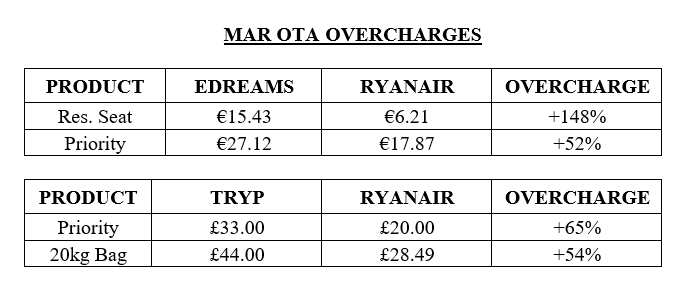
Ryanair, Europe’s No.1 low fares airline, today (Tues, 10 Mar) released its Mar OTA Survey, showing OTAs like eDreams and Tryp continue to overcharge consumers in some cases by more than double Ryanair’s website prices. These OTAs have no distribution agreements with Ryanair because their business models depend on overcharging consumers. eDreams & Tryp are this month’s worst offenders, with eDreams selling a reserved seat which costs just €6.21 on Ryanair.com for €15.43 – more than double Ryanair’s price, and Tryp selling priority boarding for £33.00, when it only costs £20.00 on Ryanair.com.
This latest survey adds to the growing evidence of a tiny number of OTAs who do not have agreements with Ryanair and who overcharge consumers, and gives further weight to the recent Italian €9m fine against eDreams for “clearly deceptive” and “misleading” pricing – further proving that OTAs like eDreams continue to overcharge consumers across Europe.
Ryanair also welcomes the recent Irish High Court order requiring eDreams to cease all direct and indirect access to our Travel Agent Direct (TAD) booking system. The Court‑recorded undertakings oblige eDreams to stop accessing Ryanair’s TAD booking system, stop using third parties to access it on its behalf, and take immediate steps to shut down any activity if it occurs. This follows Ryanair’s action this month to block eDreams’ latest attempt to sell Ryanair flights by conspiring with third parties to unlawfully access Ryanair fares and mis-sell them by breaching it’s TAD system.
Ryanair continues to campaign to protect EU consumers from OTA overcharging and calls again on EU Govts (most notably Spain’s useless Consumer Minister Bustinduy) and National Consumer Authorities to take urgent action to protect consumers from these overcharging OTAs. They should insist on mandatory price transparency from all OTAs, in line with the transparent pricing being delivered by all of Ryanair’s “Approved OTA” partners, which protects consumers.
Ryanair’s Dara Brady said:
“Ryanair’s March survey shows that OTAs like eDreams and Tryp continue to overcharge consumers, in some cases more than double the prices on Ryanair’s website. Yet still, Spain’s useless Consumer Minister Bustinduy, refuses to do anything to protect thousands of Spanish consumers from such eDreams overcharging.
This latest evidence also reflects the Italian AGCM’s €9m fine against eDreams for “clearly deceptive” and “misleading” pricing – yet another confirmation that certain OTAs’ anti-consumer practices need to be addressed across Europe.
We again call on EU Govts and Consumer Protection Authorities to take urgent action to protect consumers across Europe by insisting on OTA price transparency, in line with the transparency standards applied by all of Ryanair’s approved OTA partners.”
RYANAIR LAUNCHES ITS SUMMER ‘26 SCHEDULE FOR BARI & BRINDISI CALL ON NATIONAL GOVT. & REGION TO SCRAP MUNICIPAL TAX
04 Mar 2026
Ryanair, Europe & Italy’s No.1 airline, today (Wed, 4 Mar) launched its Summer 2026 schedule for its Apulia Airports (Bari & Brindisi) with 82 routes, incl. 3 exciting new summer routes from Bari to Bucharest, Bristol, and Trapani-Marsala. Ryanair’s Summer 2026 schedule is underpinned by Ryanair’s 5 Apulia-based aircraft (3 in Bari, 2 in Brindisi), representing a $500m investment and supporting over 5,400 jobs in the region, while driving year-round inbound tourism in the city and throughout the region
Ryanair’s Apulia S26 schedule will deliver:
82 total routes, incl. 3 new from Bari to Bucharest, Bristol, and Trapani-Marsala
5 aircraft (3 in Bari & 2 in Brindisi) – $500M invest.
Over 7M pax p.a.
Supp. 5,400 jobs
Ryanair has operated to/from Apulia for the past 22 years, carrying over 60 million passengers to date and aims to continue invest and grow traffic in Apulia region and Italy. To further grow Italian traffic and tourism, Ryanair calls on the Italian Government and its Regions to scrap the Municipal Tax at all Italian airports as Abruzzo, Calabria, Friuli-Venezia Giulia, Sicily and, most recently, Emilia-Romagna already have. This will allow Ryanair and other airlines to deliver rapid new routes, tourism, and jobs growth on a year-round basis.
Ryanair’s Head of Communications for Italy, Fabrizio Francioni, said:
“As Italy’s no. 1 airline, Ryanair is delighted to announce its Summer 2026 schedule for its Apulia airports with 82 routes, including 3 exciting new routes from Bari to Bucharest, Bristol, and Trapani, which reflect the Ryanair’s commitment to Apulia region development. To further grow Italian traffic and tourism, Ryanair calls on the Italian Government and its Regions to scrap the Municipal Tax at all Italian airports as Abruzzo, Calabria, Friuli-Venezia Giulia and, for smaller airport, Sicily and Emilia Romagna already have. Reducing access costs and removing the Municipal Tax has proven very successful in delivering transformative connectivity, tourism and jobs growth in these Regions – where we have added new based aircraft and new routes since they abolished the Municipal Tax. Should the Italian Govt abolish the municipal tax at all Italian airports, Ryanair could respond with a US$4bn investment in Italy, adding 40 new aircraft, additionally 20M pax p.a., 15,000 new Ryanair jobs and over 250 new routes”.
Antonio Maria Vasile, President of Aeroporti di Puglia, said:
“I warmly welcome the announcement of Ryanair’s Summer 2026 schedule, which further strengthens Puglia’s international connectivity and consolidates our strategic partnership with the airline, at a particularly delicate moment for the aviation sector. Precisely in such a complex phase, we continue with determination to support our tourism ecosystem, convinced that investing in routes and accessibility means reinforcing the entire regional economy.
The introduction of new destinations is a concrete sign of confidence in our territory and in the ability of our airports to sustain steady passenger traffic growth. In 2026, thanks also to Ryanair’s valuable contribution, Puglia could become one of the most visited regions in Italy. It is an ambitious yet realistic goal, built on a shared strategy of development, promotion, and strengthening of the tourism offering.
This collaboration, active for 22 years, remains a key element of our growth strategy: we continue to work on improving infrastructure, services, and the quality of the airport experience, with the aim of making our airports increasingly competitive on both the national and international stage and of consolidating Puglia’s position among the leading destinations for Italian and European tourism.
Ryanair’s Summer 2026 schedule is a sign of sustainable air traffic growth in Puglia, with positive effects in terms of employment, economic impact, and enhancement of the region’s brand. It represents a fundamental piece in guiding the region towards the goal of becoming one of the most visited in Italy.”
EDREAMS ACCEPTS COURT ORDER PREVENTING MISUSE OF RYANAIR’S TRAVEL AGENT BOOKING SYSTEM
04 Mar 2026
Ryanair today (Wed, 4 Mar) welcomed the Irish High Court’s order recording binding undertakings given by eDreams, which require the Spanish OTA to cease all direct and indirect access to Ryanair’s “Travel Agent Direct” (TAD) booking systems and to take immediate steps to prevent and stop any contractor from doing so.
Under the High Court Order, eDreams has agreed it will stop accessing Ryanair’s TAD booking system, stop using third parties to access it on its behalf, and take immediate steps to shut down any activity if it occurs. This follows Ryanair’s action last week to block eDreams’ latest attempt to sell Ryanair flights by conspiring with third parties to unlawfully access Ryanair fares and mis-sell them by breaching it’s TAD system
These developments come against a backdrop of repeated findings by European Courts and Regulators that eDreams engages in “misleading”, “deceptive” and “manipulative” commercial practices. The Hamburg Regional Court recently confirmed that eDreams’ price displays are “misleading”, that its advertised Prime “savings” could not be achieved, and that eDreams had breached an existing court order, resulting in a further fine. In Italy, the AGCM has fined eDreams €9m, ruling that its Prime scheme is “misleading” and “manipulative”, with consumers “in almost all cases” shown higher Prime prices than non‑subscribers and subjected to discriminatory “discounts”. Internal eDreams documents advocated using “reverse psychology” to drive subscriptions.
While transparent OTAs such as Booking.com, Lastminute and Kiwi have already adopted Ryanair’s price‑transparency standards, eDreams continues to refuse, because such standards would prevent it from “misleading” consumers. Ryanair has repeatedly offered eDreams free, direct API access to its fares if it adopts the same transparency standards as all approved Ryanair OTA partners – an offer eDreams continues to ignore.
Ryanair’s CMO, Dara Brady, said:
“Today’s High Court Order is a welcome development that prevents eDreams from unlawfully accessing Ryanair’s TAD booking systems. Ryanair will continue to take action to protect consumers from overcharging and from the misleading practices of screenscraping OTAs such as eDreams.
Our priority remains, ensuring passengers benefit from Ryanair’s industry‑leading transparency standards, as delivered by our approved OTA partners, and that they receive the full, direct service they are entitled to when booking Ryanair flights.”