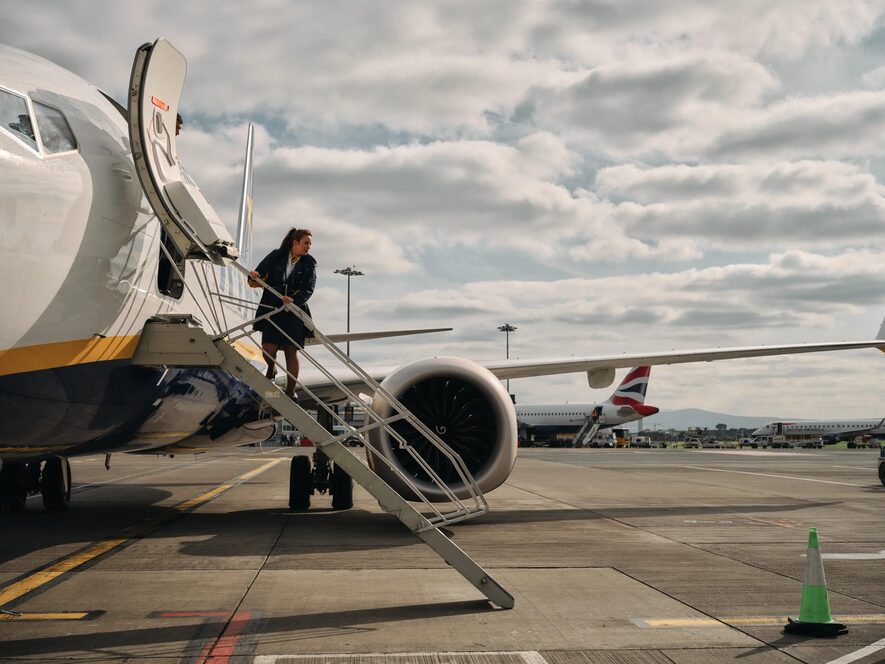
Ryanair Continues Central & Eastern European Expansion
Ryanair, Europe’s No.1 airline, today (22 Aug) announced two new Southend routes to Bucharest and Vilnius, commencing in November 2019. The new route to Bucharest will operate with a five times weekly service, while the new Vilnius route will operate three times weekly.
Ryanair continues its Central and Eastern European expansion with the launch of these new routes to Romania and Lithuania, which follows yesterday’s announcement of its entry to the Georgian market. Ryanair has the lowest fares in Europe, its average fare of just €37 is a fraction of that charged by its competitors, and with this expansion now even more customers can enjoy these low fares.
To celebrate, Ryanair has launched a seat sale with fares from just £9.99 for travel until the end of November 2019, which must be booked by midnight Saturday (24 Aug), only on the Ryanair.com website.
Ryanair’s David O’Brien said:
“Ryanair is pleased to continue its Central and Eastern European expansion with the launch of two new Southend routes to Bucharest and Vilnius, commencing in November, as part of our extended winter 2019 schedule.
Customers in Southend can now book flights to Lithuania and Romania as far out as March 2020, enjoying even lower fares and Ryanair’s great choice of destinations, with 39 countries in the Ryanair network, following our entry to the Geogian market earlier this week.
To celebrate, we are releasing seats on sale from just £9.99 for travel until the end of November 2019, which must be booked by midnight Saturday (24 Aug). Since these amazing low fares will be snapped up quickly, customers should log onto www.ryanair.com and avoid missing out.”
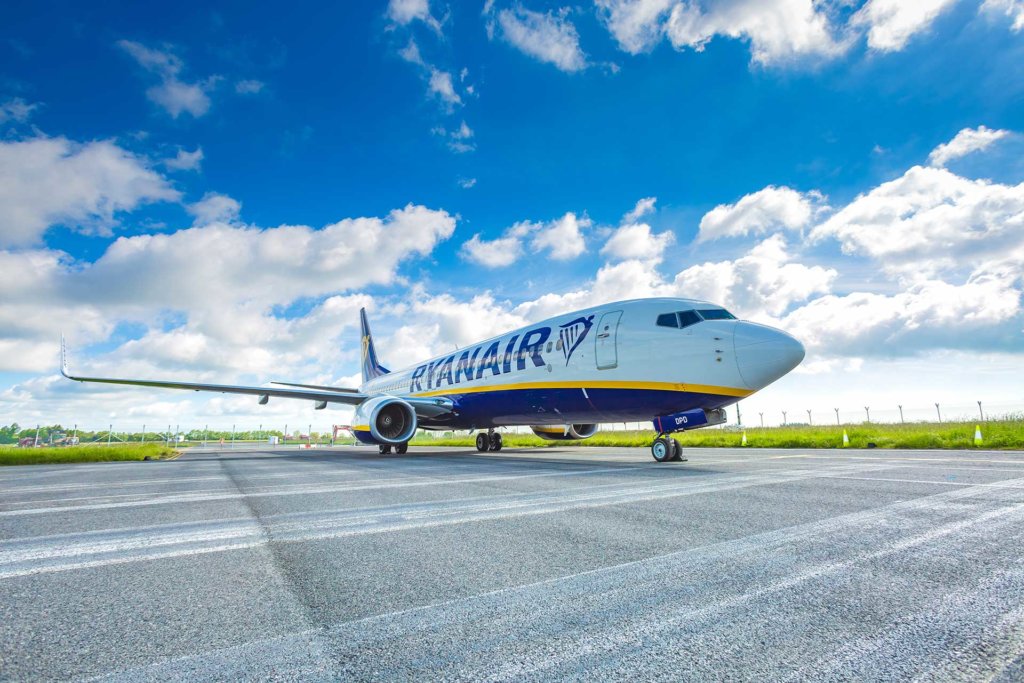
4 New Routes, 170,000 Customers P.A. At Tbilisi & Kutaisi
Ryanair, Europe’s No.1 airline, today (21 August) announced its first ever flights from Georgia, the 39th country in the Ryanair network, with a new route from Tbilisi to Milan Bergamo and two new routes from Kutaisi to Bologna and Marseille, which start in November as part of Ryanair’s Winter 2019 schedule. Ryanair will also connect Tbilisi to Cologne in April as part of Ryanair’s Summer 2020 schedule and deliver 170,000 customers annually to/from Ryanair’s Georgian airports.
Ryanair’s Georgia 19/20 schedule will deliver:
- 2 new routes from Tbilisi to Milan Bergamo (4 pw) starting from November & Cologne (2pw) from April20
- 2 new routes from Kutaisi to Bologna (2 pw) & Marseille (2 pw)
- 170,000 customers p.a.
- Over 100* “on-site” jobs p.a.
Georgian consumers and visitors can now book their holidays as far out as October 2020, enjoying even lower fares and Ryanair’s recently announced 2019 customer care improvements, including:
- Lowest Fares – find a cheaper fare within 3 hours, get paid the difference plus €5 MyRyanair credit
- Punctuality – deliver 90% target (excl. ATC) or 5% off following month’s air fares
- Customer Care Charter – EU261 claims processed in 10 days, new 24/7 support, connect in 2 mins
- Care Improvements – 48-hour free of charge grace period for changes to bookings
- Environmental Improvements – carbon offset programme, environmental partners & plastic free in 5 years
- New Ryanair Choice – €199 annual fee for free seats, fast-track & priority boarding for freq. guests
- Digital Improvements – new fare finder, sports tickets, bespoke travel guides & faster mobile
To celebrate the launch of its first Georgian airports, Ryanair has launched a seat sale with fares from just €9.99, for travel in November and December, which must be booked by midnight Friday (23 Aug) only on the Ryanair.com website.
Ryanair’s David O’Brien said:
“We’re pleased to announce Ryanair’s low fares have arrived at Tbilisi and Kutaisi, our newest airports and 1st airports in Georgia. These four new routes that will start in November (except Cologne, starting in April next year), will further promote Georgian tourism, and will deliver over 170,000 customers annually to/from two European countries to one of Europe’s fastest-growing tourism destinations. We look forward to developing new Georgian traffic growth, new routes, and jobs in the coming years.
To celebrate, we are releasing seats for sale on our network from just €9.99 for travel in November and December which are available for booking until midnight Friday (23 Aug). Since these amazing low fares will be snapped up quickly, customers should log onto www.ryanair.com and avoid missing out.”
*ACI research confirms up to 750 ‘on-site’ jobs are sustained at international airports for every 1m passengers
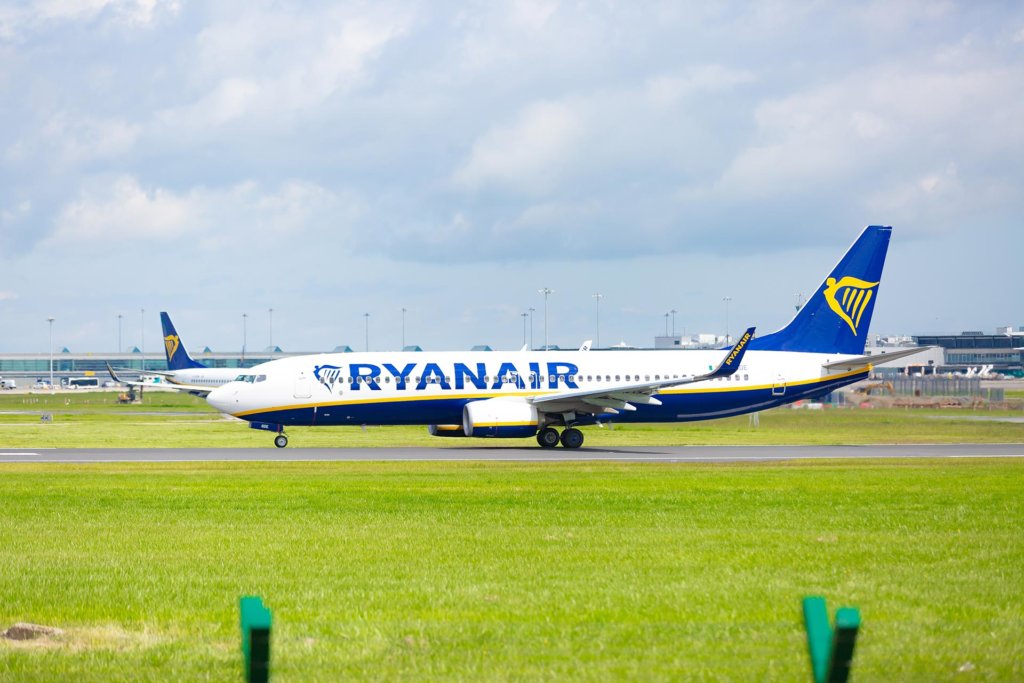
Ryanair today (8 Aug) released its July CO2 emissions statistics, which show an ave. of 67g CO2 per passenger/km.
| |
July 2019 |
| Total Kilometres |
18,832m km |
| Total Passengers |
14.8m |
| Total CO2 Emissions |
1,267 kt |
| CO2 Per Pax/km |
67g |
With the highest passenger load factor (96%) and one of the youngest fleets (ave. of 6 years), Ryanair delivers the lowest CO2 per passenger/km in the EU airline industry. Ryanair’s CO2 per pax/km has been cut from 82g to 67g over the last decade while other high fare competitors currently generate over 120g per pax/km.
Ryanair’s Kenny Jacobs said:
“Ryanair is Europe’s greenest/cleanest major airline with the youngest fleet and highest load factors. Our CO2 per passenger/km for July is 67g, half the rate of other flag carrier European airlines, and we are committed to reducing this by a further 10% to under 60g per pax/km by 2030.
As part of Ryanair’s environmental commitment, we are investing over US$20 billion in a fleet of 210 new Boeing 737 aircraft, which will carry 4% more passengers but reduce fuel burn by 16% and cut noise emissions by 40%.”
-
85% Of Customers Rate Ryanair ‘Excellent/Very Good’
-
July Worst Month So Far In 2019 For ATC Delays
Ryanair today (7 Aug) released its July customer service statistics, which show that:
- 92% of July flights arrived on-time (up from 84% July 2018) excl. ATC delays
- ATC staff shortages delayed 16,500 Ryanair flights in July – the worst so far this year
- 86 flights cancelled (down from 1,768 in July 2018)
Ryanair also released its July ‘Rate My Flight’ customer experience scores, which show 85% of over 131,000 respondents rated their flight ‘Excellent/Very Good /Good’, with high ratings for crew friendliness (91%), onboard service (89%), range of food & drink (83%), and boarding (81%).
| July – Rate My Flight |
Excellent/Very Good /Good |
| Customer Experience |
85% |
| Crew Friendliness |
91% |
| Onboard Service |
89% |
| Food & Drink Range |
83% |
| Boarding |
81% |
Ryanair’s Kenny Jacobs said:
“Ryanair carried almost 15m customers in July with over 92% of our 81,000 flights arriving on-time excl. ATC delays. While we continue to deliver industry leading punctuality, ATC staff shortages and disruptions regrettably had a huge impact in July across Europe – particularly in France, Germany, Spain, UK and Austria – making July the worst month so far in 2019 for these avoidable delays.
We’re very pleased that 85% of customers surveyed (over 131,000) rated their Ryanair flight in July as ‘Excellent/Very Good /Good’ using Ryanair’s Rate My Flight feature, which allows all customers to provide real-time reviews of their flights via the Ryanair app and email. We welcome this feedback, which encourages us to continuously improve our customer service.”
Ryanair Holdings PLC today (6 August) released July traffic statistics as follows:
| |
2018 |
2019 (LF) |
Growth |
| Ryanair Group |
13.6m |
14.8m (97%) |
+9% |
| Ryanair |
13.1m |
14.2m (97%) |
+8% |
| Lauda* |
0.5m |
0.6m (96%) |
+20% |
* Lauda traffic for July 2018, and rolling annual, includes pre-consolidation traffic.
| Rolling Annual |
134.4m |
148.2m (96%) |
+10% |
- Ryanair operated over 81,000 scheduled flights in July.
Ryanair Holdings plc today (29 July) reported a 21% fall in Q1 profits to €243m. A 6% decline in ave. fare was offset by strong ancillary revenues and 11% traffic growth to 42m guests. Costs rose 19% as our fuel bill increased 24% and Lauda costs were fully consolidated (but not in the prior year quarter).
| Q1 (IFRS) |
Jun. 2018 |
Jun. 2019 |
% Change |
| Guests |
37.6m |
41.9m |
+11% |
| Load Factor |
96% |
96% |
– |
| Revenue |
€2.08bn |
€2.31bn |
+11% |
| PAT |
€309m |
€243m |
-21% |
| Basic EPS (euro cent) |
26.62 |
21.47 |
-19% |
Ryanair’s Michael O’Leary said:
“As previously guided, Q1 profits fell 21% to €243m due to lower fares, higher fuel and staff costs.
Q1 highlights include:
- Revenue per guest flat at €55 (6% lower fares offset by 14% higher ancillary rev.)
- Traffic up 11% to 42m guests
- 239 new routes & 4 new bases (Bordeaux, Marseille, Southend & Berlin) launched
- Malta Air becomes the 4th Group airline
- Lauda Airbus fleet grows to 20 A320s
- MAX deliveries are further delayed to end of year
- Ryanair becomes first EU airline to publish monthly CO₂ emissions (66g per pax/km)
- €700m share buyback commenced in May
Revenue
Revenues rose 11% to €2.3bn. A 6% decline in average fare to €36 stimulated 11% traffic growth to 42m guests. The two weakest markets were Germany, where Lufthansa was allowed to buy Air Berlin and is selling this excess capacity at below cost prices, and the UK where Brexit concerns weigh negatively on consumer confidence and spending. Ancillaries, driven by strong priority boarding and preferred seats sales, grew 27% to €0.8bn. As a result, revenue per passenger (“RPP”) was broadly flat at €55. Ryanair Labs continues to develop services to improve customer experience and later this year will roll-out a new digital platform with improved, personalised, guest offers.
Cost Leadership
Ryanair has the lowest unit costs of any EU airline. As expected, our Q1 fuel bill increased 24% (up €150m) due to higher prices & volume growth. Unit costs ex. fuel rose by 4%, mainly due to the consolidation of Lauda (not in the prior year Q1 comp.), the handback of expensive leases to Lufthansa, replacing them with 20 lower cost A320 operating leases, and a 21% increase in staff costs. We continue to negotiate attractive growth deals as airports compete to attract Ryanair’s reliable traffic growth. Our FY20 fuel bill is 90% hedged at $709 per tonne and 37% hedged for FY21 at $632.
On-Time Performance (“OTP”)
Our investment in operational efficiency, including more spares, additional engineers and new improved handling contracts in Stansted, Spain & Poland has seen our OTP improve more than 7% points in Q1 to over 90% (excl. ATC). In June 2018 we cancelled over 1,100 flights due to ATC strikes but this was reduced to just 20 cancellations in June 2019, all of which were due to ATC staff shortage delays. Regrettably, ATC staffing delays continue to damage the punctuality of all EU airlines, particularly at weekends. We are working hard to ensure our guests enjoy on-time flights and we continue to campaign with our partners in A4E to encourage the European Commission to take action to minimise the impact of ATC staff shortages and strikes on overflights.
Boeing 737 MAX
The delivery of our first 5 B737-MAX aircraft has been delayed from Q1 to probably January at the earliest (subject to EASA approval). We now expect to receive only 30 MAX deliveries in time for S.20 (previously 58) which will cut Ryanair’s S.20 growth rate from 7% to 3% (162m to approx. 157m guests in FY21). We have great confidence that these “gamechanger” aircraft (which have 4% more seats, but burn 16% less fuel and have 40% lower noise emissions) will transform our costs and our business. Due to these delivery delays, we will not now see these cost savings delivered until FY21.
Balance Sheet
Our balance sheet is one of the strongest in the industry with over 60% of our fleet debt free. In May the Board approved a €700m share buyback programme and in Q1 we returned almost €100m to shareholders. Following the adoption of the new lease accounting standard (IFRS16) future operating lease obligations are now included on our balance sheet for the first time (adding over €220m to debt at June 30). Despite the share buyback and the impact of IFRS16, net debt was broadly flat at quarter end at €419m.
Group Airlines
In June, Malta Air became the 4th airline in the Ryanair Group. This start-up will grow our Maltese operation from 6 to 10 based aircraft over the next 3 years. It will also operate all our French, German and Italian bases. This summer, Lauda is operating 20 lower cost A320s. These aircraft, coupled with other cost efficiencies and improving ancillary revenues will significantly lower Lauda losses in Year 2, despite lower fares due to excess capacity in the German and Austrian markets. Buzz, in Poland, will operate 7 charter and 17 scheduled aircraft this summer and continues to grow profitability in its second year of operations. We expect high fuel prices and overcapacity in European short-haul to lead to further airline failures this winter creating more growth opportunities for Ryanair’s 4 airlines.
EU’s Cleanest, Greenest Airline
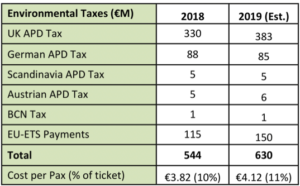
In June Ryanair became the first EU airline to report monthly CO₂ emissions. With the highest load factor, and one of the youngest fleets, Ryanair delivers the lowest CO₂ per passenger/km of any major EU airline. Our CO₂ emissions have been cut by 20% over the last decade and we are committed to reducing this by a further 10% to under 60 grams per passenger/km by 2030. In May we launched our environmental partnerships, where we invest in carbon offset projects in Africa, Portugal and Ireland. Ryanair paid over €540m in environmental taxes in FY19 and expects to pay over €630m in FY20 (up 17%).
Board Succession
Following Stan McCarthy’s appointment as Deputy Chairman in April 2019, the Board has nominated Louise Phelan to take over as Senior Independent Director in Summer 2020 following the then retirement of current SID Kyran McLaughlin from the Board.
FY20 Guidance
We continue to guide broadly flat FY20 PAT in a range of €750m to €950m. The current weak fare environment has continued into Q2 and we expect H1 fares to be down approx. 6%. With almost zero H2 visibility, FY20 fare guidance is towards the lower end of our guided -2% to +1% range. However, the strong performance of ancillaries continues to support our RPP growth of +2% to +3% (previously +2% to +4%). We expect traffic to grow by 7% to over 152m, slightly less than the 153m previously guided due to the Boeing MAX delivery delays. Costs will increase as our fuel bill grows by €450m and, as previously guided, we expect ex-fuel unit costs will rise by just 2%. This guidance remains heavily dependent on close-in Q2 fares, H2 prices, the absence of security events, and no negative Brexit developments in H2.”
“This report by Transport & Environment is based on guesswork and not facts. Claims in this report that regional airports are “likely to be in receipt of state aid” is not research, it’s guesswork. The airports they refer to represent less than 6% of Ryanair’s 152m annual traffic.
Ryanair does not receive subsidies. We negotiate arms-length commercial agreements with our airports, which all fully comply with EU competition rules. Primary beneficiaries of Ryanair’s regional flights are passengers and regional tourism – not shareholders.
Ryanair actively supports regional airports and hundreds of thousands of jobs in regional economies. Without Ryanair’s services many of these airports would close down.
Ryanair is Europe’s greenest/cleanest major airline with the youngest fleet and highest load factors. Our CO2 per passenger/km is 66g, half the rate of other flag carrier European airlines. Ryanair is committed to reducing this by a further 10% to under 60g per pax/km by 2030.
Ryanair paid over €540m in environmental taxes in 2018 and will pay over €630m in 2019 (up 17%). This equates to €4.12 per passenger, which is 11% of Ryanair’s average air fare.
As part of Ryanair’s environmental commitment, we are investing over US$20 billion in a fleet of 210 new Boeing 737 aircraft, which will carry 4% more passengers but reduce fuel burn by 16% and cut noise emissions by 40%.”
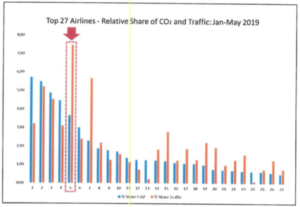
Ryanair – No. 1 for traffic while No. 5 for emissions
(Eurocontrol 2019)