Ryanair today (25 Oct) announced that it has signed Collective Labour Agreements (CLAs) with the Belgian unions CNE-CSC and LBC-NVK to cover all of Ryanair’s directly employed pilots and cabin crew in Belgium. Belgian Labour Law will apply to all Ryanair pilots and cabin crew in Belgium no later than 31st January 2019.
This follows similar agreements signed over the past week with pilot unions SEPLA in Spain, SPAC in Portugal and BALPA in the UK, covering all of Ryanair’s directly employed Spanish, Portuguese and UK Pilots.
Ryanair’s Chief People Officer, Eddie Wilson said:
“We are pleased to have signed this latest CLA covering all of our directly employed pilots and cabin crew in Belgium. These signed union agreements in Belgium, Spain, Portugal and the UK again demonstrate the considerable progress we’re making in concluding union agreements with our people in our major EU markets.
We expect that these new agreements will encourage the cabin crew unions in both Spain and Portugal to remove competitor airline employees (who have been blocking progress) and to quickly conclude cabin crew agreements in those two countries, as that’s what our Portuguese and Spanish cabin crew are now demanding.”
Ryanair today (24 Oct) announced that it has signed a recognition agreement with the Spanish pilot union SEPLA, to cover all of Ryanair’s directly employed pilots in Spain. Negotiations with SEPLA on a full Collective Labour Agreement (CLA) under Spanish Law will now commence in early November and Spanish Labour Law will apply to all Ryanair pilots in Spain by no later than 31st January 2019.
This follows other agreements signed with SPAC in Portugal, BALPA in the UK and ANPAC in Italy, covering all of Ryanair’s directly employed Portuguese, UK and Italian Pilots.
Ryanair’s Chief People Officer, Eddie Wilson said:
“These signed agreements with our pilot unions in Spain, Portugal, the UK and Italy again demonstrate the considerable progress we’re making in concluding union agreements with our people in our major EU markets.
We continue to meet with our people and their unions and we expect that these agreements will encourage the cabin crew unions in both Spain and Portugal in particular to remove competitor airline employees (who have been blocking progress) and to quickly conclude cabin crew agreements in those countries, as that’s what our Portuguese and Spanish cabin crew are now demanding.”
ENDS
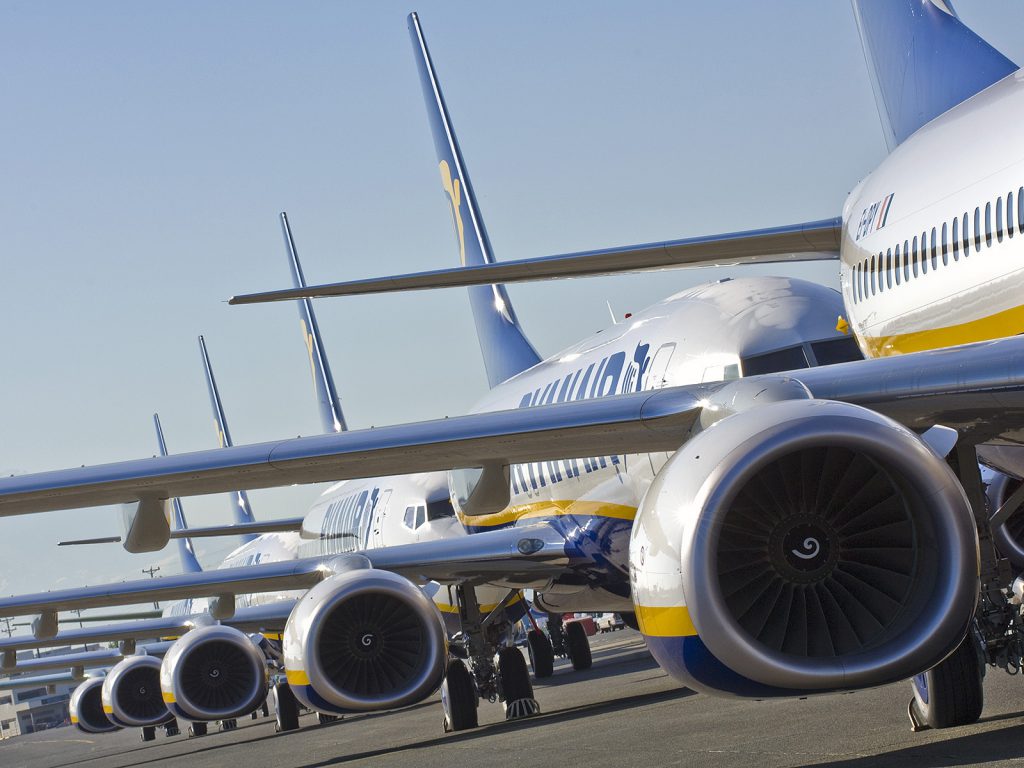
Ryanair today (22 Oct.) reported a 7% fall in H1 profits (“PAT”) to €1.20bn (excl. Laudamotion losses). Average fares declined 3% due to excess capacity in Europe, an earlier Easter in Q1, repeated ATC strikes/staff shortages which caused a spike in cancellations of higher fare, weekend flights. Higher fuel, staff and EU261 costs have offset strong ancillary revenue growth.
| H1 Results (IFRS)* |
Sep 30, 2017 |
Sep 30, 2018 |
% Change |
| Guests |
72.1m |
76.6m |
+6% |
| Revenue |
€4.43bn |
€4.79bn |
+8% |
| PAT |
€1.29bn |
€1.20bn |
-7% |
| Net Margin |
29% |
25% |
-4pts |
* excl. €45m exceptional H1 FY19 Laudamotion loss
Ryanair’s Michael O’Leary said:
“As recently guided, H1 average fares fell by 3%. While ancillary revenues performed strongly, up 27%, these were offset by higher fuel, staff and EU261 costs. Our traffic, which was repeatedly impacted by the worst summer of ATC disruptions on record, grew 6% at an unchanged 96% load factor.
H1 highlights include:
– Traffic grew 6% to 76.6m (LF 96%)
– Fare fell 3% to under €46
– Ancillary revenue rose 27% to €1.3bn
– Agreements signed with Irish, UK, Italian, Portuguese (pilots) & German (cabin crew) unions
– Laudamotion holding increased to 75%
– 23 new B737s delivered
– €540m returned to shareholders via buybacks
New Routes & Growth:
We took delivery of 23 new B737s in H1 (bringing the fleet to 450) and launched over 100 new S.18 routes. We have trimmed winter capacity by 1% (including base closures in Eindhoven and Bremen) in response to weaker fares and higher oil prices. We expect FY19 traffic will grow to 141m (incl. 3m Laudamotion). As we look beyond this winter, we have announced new S.19 bases in Bordeaux, Marseille, London Southend and increased capacity in Luton. We plan to operate over 100 new routes in S.19.
With spot fuel reaching $85bbl, rising interest rates and the stronger US dollar, airline margins are under pressure and it is inevitable that more of the weaker, unhedged, European airlines will fold this winter. In recent weeks Skyworks (Switz.), VLM (Bel.), Small Planet & Azur Air (Ger.), Cobalt (Cyprus) and Primera Air (Stansted & Scandinavia) collapsed. At the same time, many larger airlines are closing bases and cutting routes to minimise winter losses. We expect more failures this winter and we cannot rule out further capacity cuts or base closures in Ryanair if oil prices rise or air fares fall further. Over the medium term, this consolidation will create growth opportunities for Ryanair’s lowest fare/lowest cost model.
Laudamotion:
In August, we increased our holding in Laudamotion to 75%. Despite a very difficult first summer, Laudamotion will carry almost 3m guests this year but will lose approx. €150m in start-up Year 1 exceptional costs. We are working closely with the Laudamotion team who recently launched their S.19 schedule which will see them grow their fleet to 23 aircraft (including 19 A320’s). Laudamotion have reached agreement to return 9 expensive lease aircraft to Lufthansa this winter and will replace those with lower cost, longer term, operating lease aircraft, which are readily available at competitive terms as more Airbus operators fail. We are assisting them to improve cost control, fuel hedging and fleet management which will deliver significantly higher revenues and much lower costs next year as the airline moves towards break-even in its 2nd year of operation.
Ancillaries:
Our investment in Labs continues to deliver strong ancillary revenue growth. In H1 ancillaries increased by 27% to €1.3bn and drove an 8% increase in total revenue to €4.8bn. Key drivers of this growth were improved conversion of priority boarding and reserved seating. Membership of “MyRyanair” has increased to 50m members and the Ryanair digital platform now welcomes over 1bn visits p.a. A major upgrade of our digital platform is underway (website, app & 3rd party ancillary product plug-in) which will facilitate improved personalisation and capacity for traffic growth to 200m p.a. as we rollout relevant ancillary products which fit to each individual customer’s profile and buying patterns.
Cost Leadership:
No other EU airline can match, or come close to, Ryanair’s lowest unit costs and this cost gap is widening. Airports across Europe are incentivising Ryanair’s reliable traffic growth. As others fail, these incentives are improving. Thanks to our balance sheet strength, our fuel is better hedged than most European competitors with 90% of our 12 month needs (to end Sept. 2019) hedged at approx. $68bbl, well below current spot prices of close to $85bbl. FY19 is a year of investment in our people, our systems and our business as we prepare to grow to 200m guests p.a. In H1 ex-fuel unit costs increased by 7%. This includes 20% pay increases for pilots, investment in engineering headcount, pilot/cabin crew training costs and, regrettably, elevated EU261 costs arising from repeated ATC strikes/disruptions. Next spring, we take delivery of our first B737-MAX-200 “gamechanger” aircraft. These planes have 4% more seats, yet are 16% more fuel efficient, have 40% lower noise emissions, are hedged at an average €/$ rate of $1.24 (for 210 aircraft out to FY24) and they will drive continuous unit cost reductions over the next 6 years.
ATC Strikes/Staff Shortages:
Repeated ATC strikes/staff shortages means that 2018 will be the worst year on record for European ATC disruptions. These have caused widespread damage to airline punctuality and schedules. Ryanair’s H1 on-time fell to 75% from 86% (prior year), with all of this 11% decline due to ATC strikes and ATC staff shortages. We’ve invested heavily to ensure that everything we control is delivering on-time departures. We have changed our handling provider at Stansted to ensure that we receive dedicated passenger and aircraft handling, and eliminate the short staffing we suffered at times in Stansted this summer. Ryanair and other airlines have initiated legal action against the French Government to keep Europe’s skies open during French ATC disruptions. A4E (Airlines for Europe) and Ryanair are also campaigning for the European Commission to take control of the EU air space so that overflights are not disrupted during national ATC strikes. This does not alter or constrain any individual’s “right to strike” but tries to confine the impact of these ATC strikes to the actual country where the strike occurs. We continue to call for urgent action from the EC to reduce ATC disruptions in S.19.
Union Progress:
Since Ryanair agreed to recognise unions in December 2017, we’ve made good progress with our union negotiations in major markets including agreements with pilot and cabin crew unions in Ireland, Italy, the UK, Germany (cabin crew) and last week an agreement with our Portuguese pilots. We continue to engage with unions in our other major markets. Progress has been slower in other markets such as Spain & Portugal (cabin crew) and Germany (pilots) where competitor employees have interfered to delay agreements with our people and their unions. While we suffered a small number (just 8 days) of limited strikes this summer, we worked well to minimise disruptions to our customers by operating over 90% of our schedules on each of these days, thanks in large measure to the efforts of the majority of pilots and cabin crew who did not support these disruptions and worked normally. Ryanair has shown over the past 10 months that we can, and will, work with unions to reach fair and reasonable agreements for our people while retaining our competitiveness and efficiency. We can also manage strikes, although we do our utmost to avoid them. We will continue to negotiate and conclude union agreements over this winter. While we hope to finalise more union agreements in the coming months, we cannot rule out occasional industrial action, but we expect their impact to be very limited.
Brexit:
The risk of a hard (“no-deal”) Brexit in March 2019 is rising. While we hope that a 21-month transition agreement from March 2019 to December 2020 will be implemented (and extended), we remain concerned that the time to complete such an agreement is shortening. In the event of a hard Brexit our UK shareholders will be treated as non-EU. In such an event the Board will restrict the voting rights of all non-EU shareholders (and confine them to selling shares only to EU nationals) to ensure that Ryanair remains majority owned and controlled by EU shareholders. We have applied for a UK AOC to protect our 3 domestic UK routes and are on track to receive it before the end of 2018.
Guidance (excl. Laudamotion):
As updated on 1 October, FY19 PAT is guided in a range of €1.10bn to €1.20bn (excl. Laudamotion). Following a 3% reduction in H1 fares, we expect fares to fall by c.2% in H2 due to weaker than expected forward fares in Q3 (particularly the October school mid-term and Christmas) and the absence of Easter in Q4. A 1% reduction in winter capacity means that FY19 traffic will grow by 6% to 138m (141m incl. Laudamotion). Our fuel bill will be approx. €460m higher than last year and “Other Costs” will be negatively impacted by higher EU261 costs. Ancillaries continue to perform strongly although (as previously highlighted) the H2 figures will be adversely impacted by timing differences on the recognition of certain fees arising from the adoption of IFRS 15 (positive impact in H1). This guidance excludes (exceptional) start-up losses in Laudamotion of approx. €150m (which are and will be consolidated in the Ryanair Group full year financial results).
This full year guidance remains heavily dependent on air fares not declining further (they remain soft this winter due to excess capacity in Europe), the impact of significantly higher oil prices on our unhedged exposures, the absence of unforeseen security events, ATC and other strikes and the impact of negative Brexit developments. We cannot rule out further base closures or capacity cuts this winter if oil prices rise or air fares fall further. Winter trading may be positively impacted by the rate and timing of other airline failures which is already creating a ready supply of well trained pilots and cabin crew for S.19 growth.”
Ryanair today (Fri 19 Oct) announced that it has signed an agreement with the Portuguese pilot union SPAC, which will provide for seniority and base transfer agreements, to cover all of Ryanair’s directly employed pilots in Portugal. Negotiations with SPAC on a full CLA under Portuguese Law with local contracts will now commence before the end of October.
Ryanair also this week signed similar agreements with BALPA in the UK and ANPAC in Italy covering all of Ryanair’s directly employed UK and Italian Pilots. Following negotiations in Madrid this week, Ryanair also expects to sign a recognition agreement with Spanish pilot union SEPLA shortly, which will pave the way for rapid negotiations on a CLA, and under Spanish law.
Ryanair’s Chief People Officer, Eddie Wilson said:
“These signed agreements with our pilot unions in Portugal, the UK, Italy and shortly in Spain, demonstrate the considerable progress we’re making in concluding union agreements with our people in our major EU markets.
The recent wave of airline failures in Europe including Primera Air, Cobalt, Air Azur, and Small Planet (GER), as well as base closures/cuts announced by many of Europe’s major airlines in response to higher oil prices and lower air fares, have given a significant stimulus to these union negotiations over recent weeks. Ryanair’s pilots and cabin crew recognise that they enjoy better pay, better rosters, and significantly better job security than their counterparts at many other EU airlines, and we for our part, are recognising and working with unions to conclude agreements which address the major issues of concern to our pilots and cabin crew in all our major EU markets.
I expect that these agreements in Spain, and Portugal in particular, will encourage the cabin crew unions in both those countries to remove competitor airline employees (who have been blocking progress) and to quickly conclude cabin crew agreements in those countries, as that’s what our Portuguese and Spanish cabin crew are now demanding.”
ENDS
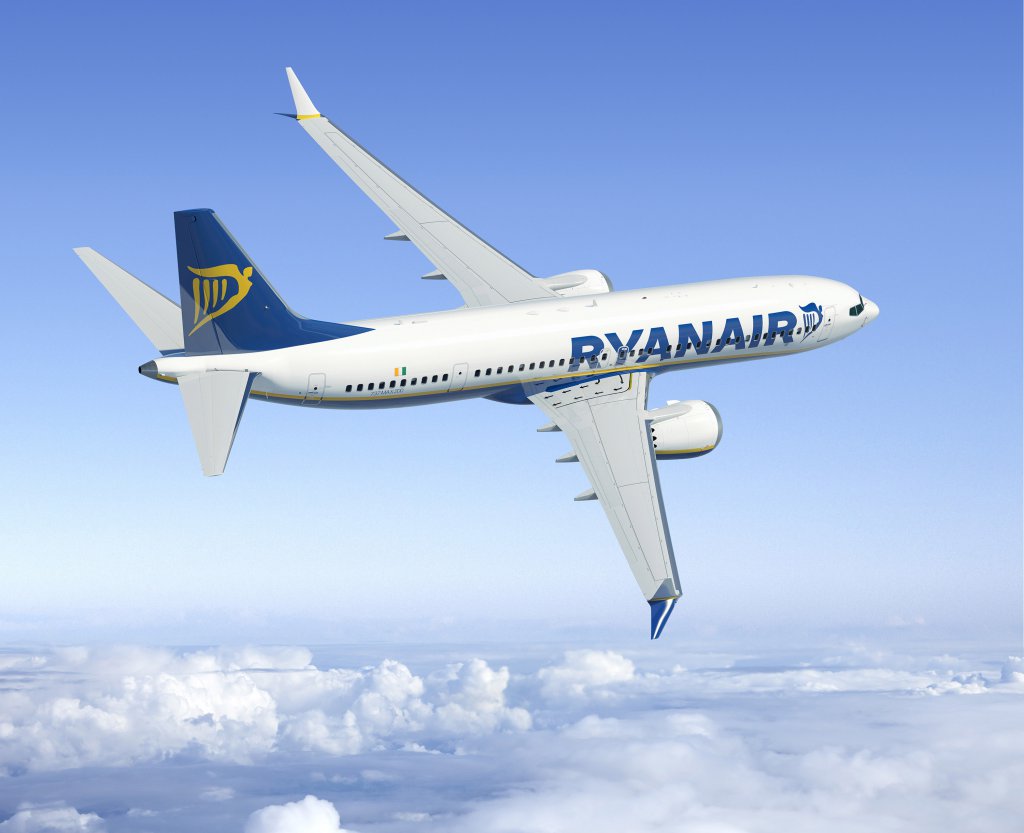
Ryanair, Europe’s No.1 airline, today (10 Oct) announced a new route from Sofia to Chania, with a twice-weekly service commencing in April 2019, which will be a part of Ryanair’s Summer 19 schedule.
Bulgarian consumers and visitors can now enjoy even lower fares and the latest “Always Getting Better” improvements including:
– Reduced checked-in bag fees
– lower €25 x 20kg check bag
– lower €8 x 10kg check bag
– Ryanair Rooms with 10% off Travel Credit
– Ryanair Transfers
– wider choice of ground transport with new partner Car Trawler
Ryanair’s Olga Pawlonka said:
“Ryanair is pleased to announce a new Sofia route to Chania, commencing in April 2019, which will operate twice-weekly as part of our Summer 2019 schedule.
To celebrate we are releasing seats for sale from Sofia from €9.99 for travel in October to December. This offer is available for booking until midnight Thursday (11 Oct). Since these amazing low fares will be snapped up quickly, customers should log onto www.ryanair.com and avoid missing out.”
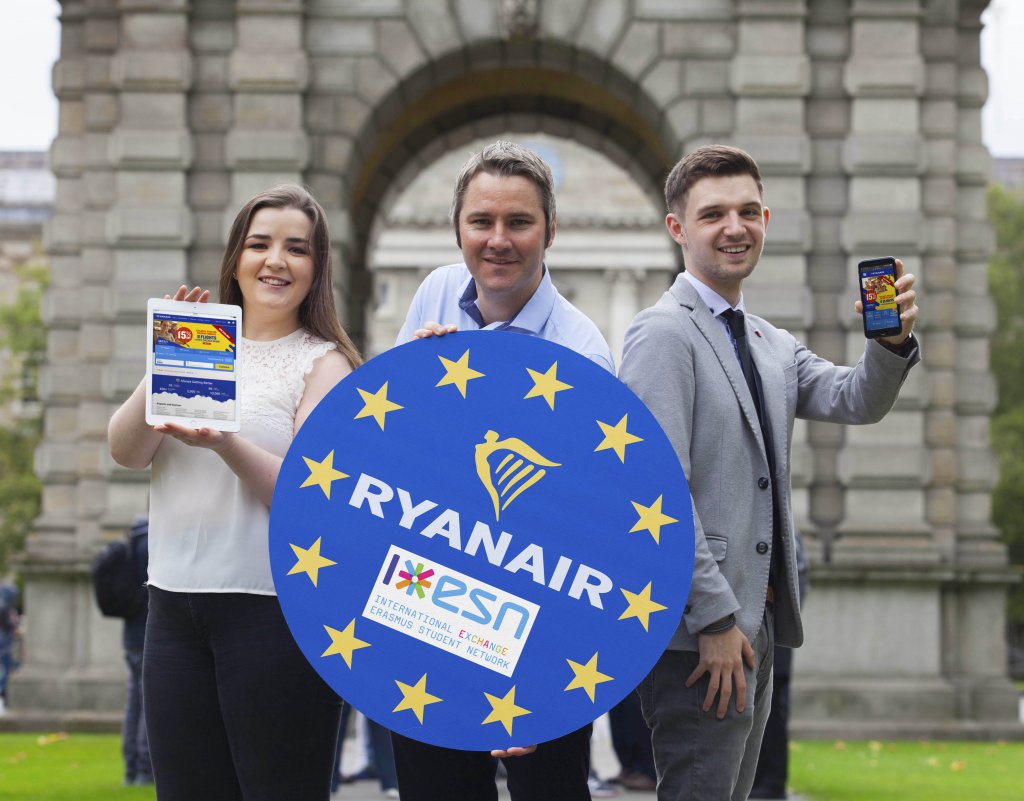
Erasmus Students Save Over €5m So Far With Ryanair
Ryanair, Europe’s favourite airline, today (8 Oct) officially launched the second year of its exclusive partnership with the Erasmus Student Network..
Delivered as part of Ryanair’s “Always Getting Better” programme, this partnership offers Erasmus students a dedicated ESN booking platform where they can avail of 15% flight discounts on the Ryanair.com website, and a free checked-in bag with every flight booked, saving ESN members an average of €33 per flight.
Over 150,000 ESN members signed up during the first year of the partnership, saving over €5m on their travel costs. Students can now sign up once again this year, with ESN membership available at over 500 Universities across almost 50 countries, and avail of these exclusive travel discounts with Ryanair.
Ryanair’s Head of Communications Robin Kiely said:
“After the huge success of Year 1, we’re now pleased to launch the second year of our partnership with the Erasmus Student Network. Ryanair and Erasmus have done more to promote mobility, particularly youth mobility, and European integration than perhaps any institution over the past three decades. More than 150,000 students signed up to Ryanair’s exclusive partnership with ESN in the first year, saving themselves over €5m, and as students head back to university this month, we encourage all ESN members to sign up this year.
Any Erasmus student with a valid ESN card can sign up via the “MyRyanair” registration service and save even more while they travel on Europe’s biggest airline with the widest route network and the lowest fares.”
President of Erasmus Student Network, João Pinto said:
“ESN cooperation with Ryanair was meant to happen. Both organisations promote international mobility at its highest level – especially for young people on a budget. This partnership increases their opportunities to go abroad and discover other cultures, leading to multicultural understanding and a more inclusive society. The Erasmus+ programme has proven this possible and ESN is boosting its effects hand in hand with Ryanair.”
For more information visit https://www.ryanair.com/ie/en/plan-trip/explore/erasmus
Ryanair, Europe’s No. 1 airline, today (4 Oct) welcomed the Commercial Court of Barcelona’s recent ruling confirming that no EU261 compensation is due to customers whose flights are cancelled because of internal strike action, as such strikes are beyond the airline’s control.
Ryanair fully complies with all EU261 legislation and has re-accommodated or refunded all customers affected by the small number of strike cancellations, and provided full assistance to customers where needed, including accommodation, meals and rerouting.
However, as these cancellations are beyond Ryanair’s control, no EU261 compensation payments are due, as confirmed by this Barcelona court ruling, the ninth such recent Spanish court ruling, following similar decisions in the Courts of Badajoz, Ourense and Pontevedra.
Ryanair’s Kenny Jacobs said:
“We welcome this ruling by the Commercial Court of Barcelona confirming that no compensation is payable to customers when the (strike) delay/cancellation is beyond the airline’s control. If these strikes, by a tiny minority of Ryanair crew, were within Ryanair’s control, there would be no strikes and no cancellations.
In recent years during which there were over 15 days of pilot and cabin crew strikes in Germany, Lufthansa was not required to pay EU261 compensation. Similarly, the UK CAA should also explain why it took no EU261 action against BA during last year’s cabin crew strikes.”
ENDS