RYANAIR Q1 PAT FALLS 34% TO €538M AS UNHEDGED OIL PRICES SPIKE. TRAFFIC GROWS 6% AT LOWER FARES
20 Jul 2026
Ryanair Holdings plc today (20 July) reported Q1 PAT of €538m, down 34% on PY Q1 PAT of €820m as the price of its 20% unhedged jet-fuel spiked and fares fell 6%, primarily due to the impact of the Middle East conflict and the first part of Easter holiday falling into PY Q4.
Q1 Ended:
Jun. 2025
Jun. 2026
+/-
Passengers
57.9m
61.3m
+6%
Load Factor
94%
94%
–
Revenue (€)
4.34bn
4.38bn
+1%
Op. Costs (€)
3.42bn
3.81bn
+11%
PAT
€820m
€538m
-34%
Q1 highlights include:
Traffic grew 6% to 61.3m.
Rev. per pax fell 5% (ave. fare down 6% & ancil rev. flat).
Unit costs rose 5% as unhedged Q1 jet-fuel prices doubled to $150bbl.
FY27 jet-fuel is 80% hedged @ $67bbl. FY28 now 15% hedged at $85bbl.
3 new bases (Rabat, Tirana & Trapani) and 130 new S.26 routes.
Final €1.2bn bond repaid in May, leaving the Group now debt free.
Ryanair CEO Michael O’Leary, said:
Revenue & Costs:
“In Q1 Revenue rose 1% to €4.38bn. Scheduled revenue dipped 1% to €2.91bn as traffic grew 6% but at 6% lower fares. Q1 fares (which benefitted from a full Easter during April 2025) required stimulation as the Middle East conflict led to consumer hesitancy, concerns about EU jet-fuel shortages, economic uncertainty and later bookings. Ancillary revenue grew in line with traffic to €1.47bn. Operating costs rose 11% to €3.81bn as the price of our 20% unhedged jet-fuel more than doubled in Q1, while supplier compensation ceased following delivery of our final B-8200 “Gamechanger” in February 2026.
Ryanair’s conservative hedging policy (FY27 fuel is 80% hedged at c.$67bbl) insulates Group earnings during volatile oil markets and widens our cost advantage over all other EU competitors. We recently extended our fuel hedges (on price dips) into FY28 which is now 15% hedged at c.$85bbl.
Balance Sheet & Liquidity:
Our industry leading balance sheet is underpinned by an unencumbered B737 fleet of 620 aircraft, BBB+ credit ratings and very strong liquidity. At 30 June gross cash was over €2.8bn, after €1.3bn debt repayments and €0.5bn capex. Liquidity is further boosted by the Group’s €1.1bn RCF which is mostly undrawn. This financial strength widens the cost gap between Ryanair and competitor airlines, many of whom are exposed to rising (long-term) finance costs, expensive aircraft leases and unhedged jet-fuel.
We are now c.90% through our €750m buyback programme (over 25m shares purchased and cancelled at an ave. price of €26.35 per share). Over the coming year (following the May repayment of our last €1.2bn bond) our funding priorities include MAX-10 aircraft capex, shareholder dividends and the completion of the current buyback programme from internal cashflows while rebuilding the Group’s gross cash back to €4bn.
FLEET & GROWTH
The Group’s fleet of 647 aircraft (incl. all 210 B-8200 “Gamechangers”), facilitates 4% FY27 traffic growth to 216m passengers. Boeing continues to expect MAX-10 certification in late summer 2026 and plans to deliver Ryanair’s first 15 MAX-10s on time in Spring 2027, with 300 of these super fuel-efficient aircraft (20% less fuel & 20% more seats) due to deliver by Mar. 2034.
For S.26, Ryanair has opened 3 new bases (Rabat, Tirana and Trapani) and 130 new routes, now on sale. With only 4% FY27 traffic growth, our scarce capacity is being switched to those States, Regions and Airports cutting aviation taxes and lowering fees to incentivise growth (such as Albania, Italy, Morocco, Slovakia and Sweden) as we withdraw flights and traffic away from high tax/high cost markets like Austria, Dublin, Germany and Regional Spain.
We expect European short-haul capacity to remain constrained until at least 2030 as the 2 main OEMs remain well behind on aircraft deliveries, Pratt & Whitney engine repair delays continue, EU airline consolidation accelerates and unprofitable airlines (hit by higher jet-fuel prices and strong US dollar) face a difficult winter. Industry capacity constraints, combined with our widening cost advantage, strong balance sheet, low-cost (fuel-efficient) aircraft orderbook and industry leading ops resilience will, we believe, facilitate Ryanair’s sustainable, profitable growth to over 300m passengers p.a. by FY34.
ESG
During Q1 the Group recorded a record 91% customer satisfaction (CSAT) score (up 2% pts on PY). Our ongoing investment in new technology and operational resilience, coupled with ambitious SAF targets, makes Ryanair one of Europe’s most environmentally efficient airlines. This summer the Group is operating 210 Gamechanger aircraft (4% more seats, 16% less fuel) and preparations are well underway for the first MAX-10s in Q4 (20% more seats & 20% less fuel). We’ll also complete the winglet retrofit programme on all our B737NG fleet (1.5% lower fuel burn and 6% less noise) this winter.
OUTLOOK
FY27 traffic remains on track to grow 4% to 216m passengers (H1 +6% & H2 +2%). Our unit cost leadership continues to widen. Our jet fuel is 80% hedged to March 2027 at c.$67bbl, insulating earnings from oil price volatility and helping offset a €300m increase in EU enviro. taxes, significant crew pay increases under new multi-year CLAs and higher maintenance. Final FY27 unit costs will depend on the price of our 20% unhedged jet fuel over the remaining 3 quarters. While S.26 volumes are strong, the booking window remains closer-in than last year which further reduces visibility. Despite a recent, slight, uptick in volumes, and less price stimulation, Q2 pricing is trending modestly down (y-o-y) and the final H1 fare outcome is heavily dependent on the strength of close-in bookings in Aug. and Sept. As is normal this early in the year, we have zero H2 visibility so it remains far too early to provide any meaningful FY27 PAT guidance.
The final FY27 PAT remains highly sensitive to adverse external developments, incl. conflict escalation in the Middle East and Ukraine, the price of unhedged jet-fuel, macro-economic shocks and continuing European ATC strikes & mismanagement.”
ENDS
RYANAIR LAUNCHES RECORD WINTER 2026 SCHEDULE WITH 80M SEATS ACROSS EUROPE
17 Jul 2026
Ryanair, Europe’s No.1 airline, today (16 Jul) launched a record schedule for Winter 2026, with 1,700 routes across 35 countries, including over 140 new routes. Ryanair’s record Winter 2026 schedule offers customers even more choice for their Winter 2026 getaways, including top winter sun destinations, ski trips, Christmas markets, or city escapes, at the lowest fares in Europe.
Ryanair’s full Winter 2026 schedule is available to book now via the Ryanair App / website.
RYANAIR CALLS ON “USELESS” VON DER LEYEN TO TAKE ACTION ON ATC DELAYS AS THE FRENCH SENATE ADMIT THAT FRENCH ATC IS “WORST IN EUROPE” AND COSTS AIRLINES €800 MILLION IN 2025
09 Jul 2026
VON DER LEYEN TALKS ABOUT COMPETITIVENESS BUT DOES NOTHING TO DELIVER IT
Ryanair, Europe’s No.1 airline, today (9 July) called on “Useless” von der Leyen, the EU Commission President, to stop talking about competitiveness and instead deliver. Ryanair has forwarded a letter to President Von der Leyen, enclosing a report from the French Senate which confirms that French ATC is “the worst in Europe”, with French ATC delays increasing by 60% in 2025 over 2019 delay levels.
While European ATC fees rise at last in tandem with ATC flight delays, President von der Leyen sits in Brussels doing nothing about EU air traffic control delays or cost inflation other than making empty speeches about competitiveness but she fails to deliver anything.
European airlines have repeatedly called on President von der Leyen to deliver real reform of European ATC by: (1) mandating that all ATC providers are fully staffed for the first wave of morning flights or suffer fines; and (2) protect overflights during national ATC strikes. Despite spending 2 years talking about competitiveness (since the 2024 Draghi Report), “Useless” von der Leyen has done nothing to deliver any real change. She loves talking about competitiveness while doing absolutely nothing to deliver it. Even the French Senate now admits that French ATC is “the worst in Europe” and cost EU airlines €800m in 2025. Yet EU airlines are prohibited from recovering these costs from Europe’s failing ATC providers. This failure has to change.
Ryanair CEO Michael O’Leary said:
“It is time for Useless von der Leyen to stop talking about competitiveness and start delivering it. For many years now, Europe’s airlines have called for effective reform of Europe’s failing ATC services. At a minimum, this requires the Commission to mandate that Europe’s ATC providers are fully staffed for the first wave of morning flights or face real and penal fines. We also have called for protection of overflights during national ATC strikes. Despite these repeated calls, Useless von der Leyen has done nothing. She is great at giving speeches but is useless when it comes to delivering real reform or competitiveness in Europe.
2 years after the Draghi Report gave Europe the roadmap for improving competitiveness, Useless von der Leyen has delivered nothing. No change, no reform, no improvement in either the cost or delays imposed on EU citizens by ATC delays, and no real reform of ETS taxation either. This is a useless President who loves giving speeches, but when it comes to delivering reform for Europe’s citizens, she hides in the Berlaymont doing nothing. It is time for Useless von der Leyen to deliver real reform or resign and let somebody competent deliver the competitiveness and change that Mario Draghi called for in his 2024 report.
The fact that the Draghi Report has sat on the shelves in President von der Leyen’s office gathering dust is another stunning indictment of her abject failure to lead Europe, or to deliver competitive reforms for European citizens, while US and Chinese competitors streak ahead of failing Europe. One of the few industries where Europe leads the world is low-fare air travel. We have a more competitive airline industry in Europe than exists in either China or North America. Yet we have seen no delivery from President von der Leyen to reform Europe’s failing ATC or to abolish our penal and discriminatory environmental taxes. It is indefensible that Europe continues to tax its own citizens on intra-EU flights with ETS, while exempting all non-EU flights, despite the fact that these flights account for more than 50% of the EU CO2 emissions.
Yet again, Useless von der Leyen makes speeches but delivers no real reform. She should quit and let somebody competent deliver the reform, and competitiveness that Europe so badly needs, but which she has totally failed to deliver.”
RYANAIR WARNS FAMILIES FACE PASSPORT QUEUE CHAOS AS EES ROLLOUT COLLIDES WITH PEAK SUMMER SEASON
02 Jul 2026
URGES EUROPEAN GOVTS TO POSTPONE EES UNTIL SEPTEMBER TO AVOID TRAVEL NIGHTMARE DURING SCHOOL HOLIDAYS
Ryanair, Europe’s No.1 airline, today (Thurs, 2 Jul) warned that the EU’s passport control Entry/Exit System (EES) is not ready for the end-of-school-term travel period, as millions of families prepare to travel across Europe for their well-deserved summer holidays.
With peak summer travel now approaching, Ryanair is again calling on European Govts to suspend the rollout of EES until September, when the busiest travel period has passed, to prevent passengers – many travelling with young families from being forced to suffer long and avoidable passport control queues.
To help customers prepare for potential airport disruption and prevent them from missing their flights, Ryanair is advising passengers of the increased queues at passport control when travelling to non-Schengen destinations, and to arrive earlier at the airport.
Checks may require scanning passports, providing fingerprints and having a facial image taken, for which the current infrastructure is NOT ready to manage the high passenger volumes expected during peak season, due to insufficient staff, kiosks and system readiness. Airports such as Tenerife South, Palma, Alicante, Malaga, Milan Bergamo, Krakow and Paris Beauvais are experiencing major disruptions, with further congestion expected as we enter the busiest weeks of summer.
Ryanair has reiterated its concerns to the Govts of the most exposed countries, urging them to take action, protect consumers during a crucial period and postpone EES until September, as permitted under EU law. However, despite the clear impact on passengers and families this summer, there has been zero response to fix this major challenge.
“As schools break up and Europe enters the busiest travel period of the year, it is clear that EES is still not ready for peak summer volumes. Passengers and families should not be used as guinea pigs for a half-baked passport control system that risks creating long queues, missed flights and unnecessary stress at airports this summer.
It is as simple as postponing EES until September, as other EU countries like Greece have already done. Ryanair calls on European Govts once again to delay the implementation to protect passengers, families and airport operations during the school holiday rush, instead of forcing holidaymakers to endure needless passport control chaos.”
RYANAIR CALLS ON FRENCH GOVT TO FIX EUROPE’S WORST ATC PROVIDER
02 Jul 2026
SENATE REPORT EXPOSES DECADES OF FAILURE AS IT CONFIRMS DSNA IS WOEFULLY MISMANAGED ANDUNABLE TO COPE WITH TRAFFIC GROWTH
FRENCH ATC DELAYS SET TO COST AIRLINES €1.7BN P.A. BY 2035 UNLESS URGENT ACTION IS TAKEN
Ryanair, Europe’s largest airline, today (2 Jul) called on the French Govt to urgently reform French ATC, following the publication of a damning report by Senator Vincent Capo-Canellas which confirms that France’s air traffic control provider, DSNA, is understaffed, underproductive, reliant on obsolete technology, and incapable of coping with future traffic growth unless urgent reform is delivered now.
The report warns that, if no new measures are introduced, Eurocontrol estimates that by 2030 French ATC will no longer be able to handle demand for flights, meaning that “a portion of flights will inevitably and structurally have to be cancelled.” This is an incredible admission of failure from Europe’s largest overflight country and is unacceptable for passengers, airlines and Europe’s single aviation market. France does not have a traffic growth problem, France has an ATC management problem.
The ongoing capacity crisis once again exposes the failure to protect overflights during French ATC strikes. While minimum service rules shield many domestic French flights, passengers travelling between other EU countries continue to suffer unnecessary delays and cancellations when flights overflying France are disrupted. The French Govt and European Commission must urgently protect overflights during French ATC strikes, as happens elsewhere in Europe, while fully respecting the right of French ATC unions to strike. France already protects many domestic flights during ATC strikes. It must now protect overflights as well.
The report highlights the scale of French ATC mismanagement, with French ATC delays forecast to cost airlines up to €1.7bn p.a. by 2035, while 30% of French controllers are due to retire by 2035, worsening existing staff shortages. Despite this looming capacity crisis, French ATC productivity remains below the EU average, taking approximately 5 years to train a controller in France, compared with its European countries such as the UK and Ireland, where training takes less than 2 years.
The Senate report also exposes the ongoing failure of DSNA’s long-delayed modernisation programme, with key projects running 13 years behind schedule. DSNA continues to rely on obsolete infrastructure, including paper flight strips and 1990s radio systems, with spare parts now running out. Ryanair said the report is a clear admission that French ATC is not fit for purpose and that urgent structural reform is required to prevent France becoming a permanent bottleneck in European airspace.
Ryanair is calling on the French Govt to implement immediate reforms, including uncapped recruitment of air traffic controllers until 2030 to address controller shortages and looming retirements. These reforms must also include guaranteed protection for overflights during French ATC strikes, so that flights between non-French countries are not unnecessarily cancelled or delayed by French industrial action. DSNA’s budget should be separated from French State budget constraints so that ATC charges are reinvested directly in staffing, capacity and modern systems, rather than being trapped in wider State budget restrictions.
Ryanair also called on the French Govt to shorten ATCO training times to align with European countries, where controllers can be trained in less than 2 years, and to carry out a full review of rostering and operational practices to improve productivity and capacity. Urgent investment is needed to replace DSNA’s ancient equipment and ensure obsolete systems do not shut or restrict French airspace in the years ahead. The time for excuses is over, the French Govt must fix French ATC now.
“This French Senate report confirms what airlines and passengers have known for years – French ATC Europe’s weakest link: woefully mismanaged, understaffed, underproductive and still using technology that belongs in a museum. It is extraordinary that France is still using paper flight strips and outdated radio systems while its so-called modernisation programme is more than a decade behind schedule. This is not bad luck. This is not a funding problem. This is a management failure.
The report makes clear that, without urgent reform, France will no longer be able to handle flight demand by 2030, a completely unacceptable situation for a monopoly service provider. This would be a disaster for passengers, airlines and Europe’s aviation market, with French ATC delays set to cost airlines up to €1.7bn per year by 2035.
It is also unacceptable that French ATC strikes continue to cause unnecessary disruption to overflights between two non-French countries. France already protects domestic flights during ATC strikes through minimum service rules, yet passengers flying over France, for example between Ireland and Spain, or the UK and Italy are still unfairly delayed or cancelled. The French Govt and the EU Commission must now protect overflights during French ATC strikes, while respecting the right of French ATC unions to strike.
The French Govt must now act. DSNA needs uncapped controller recruitment to 2030, shorter training times, better rostering, improved productivity and a dedicated budget that ensures ATC charges are reinvested in modern systems and capacity. France cannot be allowed to become the permanent bottleneck of European airspace because of years of ATC mismanagement. Europe’s aviation network should not be held hostage by DSNA’s failure to recruit, modernise and improve productivity.
The time for excuses is over. The time for reform is now.”
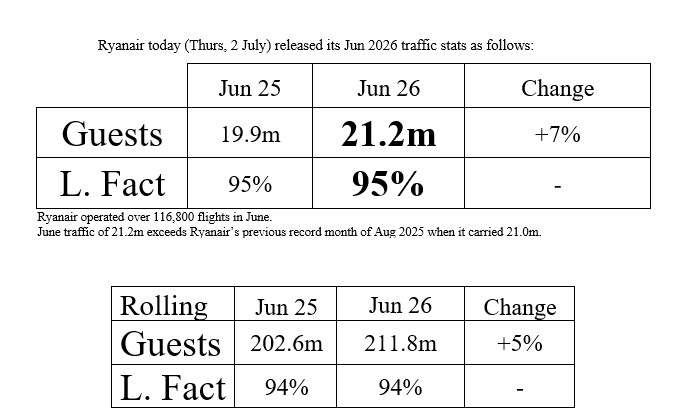
RYANAIR JUNE TRAFFIC GROWS 7% NEW RECORD MONTH OF 21.2M GUESTS
02 Jul 2026
RYANAIR TWEAKS SEAT ALLOCATION FOR FAMILIES TO MATCH INDUSTRY STANDARD
25 Jun 2026
FREE PARENT SEATS NOW AVAILABLE IN REAR OF AIRCRAFT BUT FAMILIES CAN STILL CHOOSE THEIR PREFERRED SEATS IF THEY SO WISH
Ryanair, Europe’s largest airline, today (25 June) confirmed that its long-standing family seating policy fully complies with all relevant laws and regulations. Ryanair does not charge any fee for children to sit beside their parent or accompanying adult. Like all adults who select a reserved seat, adults travelling with children pay one reserved seat fee, but can select reserved seats beside them for up to 4 children on the same booking free of charge. This means that parents travelling with children pay for only one (adult) reserved seat – at a discounted rate – but pay nothing for the 4 other reserved seats for the children travelling with them. This policy has given families certainty of seat allocation at the time of booking, which families have valued as much as they have valued Ryanair’s lowest fares.
For bookings from today (25 June), adults travelling with children, who do not wish to select or pay for a reserved seat, will be advised of their (free of charge) seat allocation after they have checked in for their flight, as is the case with most other airlines in Europe. Families opting for this random allocation of seats beside each other are likely to be seated towards the rear of the aircraft cabin, as front rows tend to be reserved and sell out first. Families who prefer to choose their seats at the time of booking and secure premium front rows will be allowed to do so by paying a seat reservation fee, in line with the policy applied by most other European airlines. This minor policy tweak will align Ryanair’s family seating policy with that of most other EU airlines, which responds to the desire of Europe’s regulators to stifle innovation and progress. The tweak will be revenue-neutral for Ryanair while families will continue saving €billions every year by choosing to travel on Europe’s lowest fare airline.
Ryanair CEO, Michael O’Leary, said:
“European regulators such as the UK CMA have consistently failed consumers by ignoring blatant anti-consumer reselling of inflated air fares by unauthorised OTAs, overcharging by airport monopolies and service failures by Europe’s ATCs. Turning a blind eye to the high fares charged by airlines on routes with no Ryanair competition, the CMA has now targeted our family seating policy which has been universally embraced by consumers as the most progressive and transparent in Europe. Instead of promoting competitiveness and lower fares for consumers, the CMA is on a mission to force Ryanair to adopt the less transparent and less consumer-friendly family seating policy applied by most other airlines – just because it’s the industry standard.
We will reluctantly adjust to this industry standard as we don’t want to waste time explaining to misguided regulators how badly they misunderstand what is in the best interest of UK and Europe’s consumers. Under our revised family seating policy, families may have to wait until after they have checked in to find out their seat allocation and are more likely to be seated at the rear of the cabin but at least the CMA will be able to claim they have done something for consumers, but sadly most consumers won’t notice.”