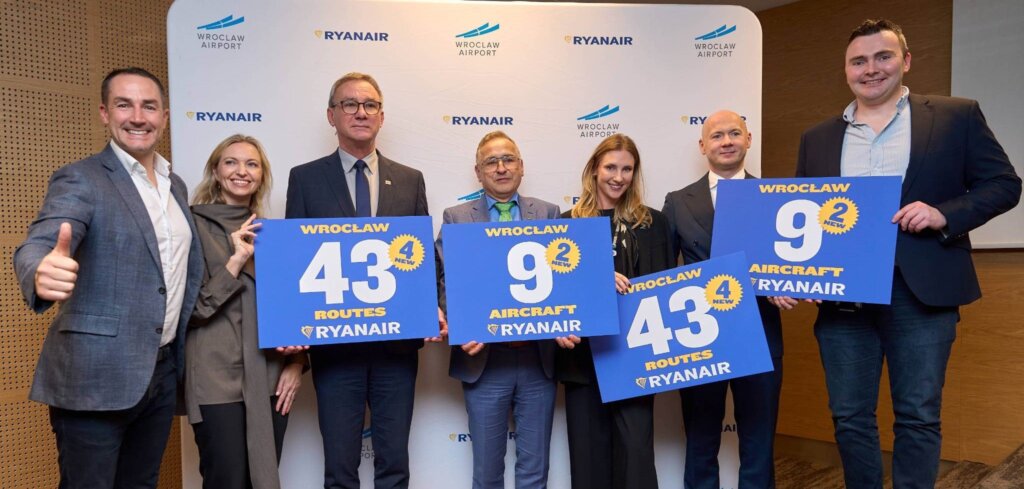
9 ZBAZOWANYCH SAMOLOTÓW (2 NOWE), WZROST O 35% (1,3 MLN MIEJSC W SAMOLOTACH) I 4 NOWE TRASY
Ryanair, największa linia lotnicza w Europie i w Polsce, ogłosiła dzisiaj (16 września) rekordowy rozkład lotów sezon Zima’26 dla Wrocławia. W ramach nowej siatki połączeń we Wrocławiu zbazowanych będzie 9 samolotów (+2 w porównaniu z zimą 2025 r.). Ta inwestycja w wysokości 900 mln USD na Dolnym Śląsku zapewni 1,3 mln miejsc w samolotach (330 tys. dodatkowych, wzrost o 35%), cztery nowe atrakcyjne trasy do Madrytu, Marrakeszu, Tirany i Turynu, a także zwiększoną częstotliwość lotów na 15 obecnych trasach oraz utrzymanie ponad 2,5 tys. miejsc pracy.
Rozkład Zima’26 z Wrocławia to:
- 9 zbazowanych samolotów (+2 w porównaniu z rozkładem Zima’25 – inwestycja o wartości 900 mln USD)
- 43 trasy, w tym cztery nowe do Madrytu, Marrakeszu, Tirany oraz Turynu
- zwiększoną częstotliwość lotów na obecnych 15 trasach – w tym do Dublina, Londynu, Malty i Palermo
- 1,3 mln miejsc w rozkładzie Zima’26 (wzrost o 330 tys. /+35% w porównaniu do Zimy’25)
- ponad 3 mln pasażerów rocznie
Wraz z ogłoszeniem zimowego rozkładu lotów z Wrocławia, Ryanair przygotował ograniczoną czasowo promocję. Bilety w cenach od 119 PLN są dostępne w aplikacji Ryanair oraz na stronie www.
Jason McGuinness, Chief Commercial Officer w Ryanair, powiedział:
„Z przyjemnością ogłaszamy, że w sezonie zimowym 2026 r. linie Ryanair zbazują dwa dodatkowe samoloty, powiększając flotę do 9 samolotów zbazowanych we Wrocławiu, co oznacza łączną inwestycję na Dolnym Śląsku
w wysokości 900 mln USD. Dzięki temu tej zimy zaoferujemy ponad 1,3 mln miejsc (330 tys. dodatkowych, wzrost
o 35%) oraz 43 trasy, w tym cztery nowe połączenia do Madrytu, Marrakeszu, Tirany i Turynu, zapewniając pasażerom we Wrocławiu jeszcze większy wybór w najniższych cenach w Europie.
Dziewięć samolotów zbazowanych we Wrocławiu oraz inwestycja o wartości 900 mln USD to wyraźne zobowiązanie Ryanair do rozwoju regionalnych połączeń w Polsce. Zimą tego roku Wrocław zyska dodatkowe 330 tys. miejsc oraz 4 nowe trasy i zwiększoną częstotliwość na 15 istniejących trasach obsługiwanych przez największą linię lotniczą
w Europie i Polsce, co pobudzi turystykę przyjazdową na Dolnym Śląsku i zapewni całoroczne połączenia międzynarodowe w najniższych cenach w Europie.
Dzisiejsze ogłoszenie zimowej siatki stanowi zwieńczenie rekordowego roku pod względem inwestycji i rozwoju linii Ryanair w Polsce, w którym linia dysponowała 52 samolotami zbazowanymi w Polsce (inwestycja o wartości 5,2 mld USD), zaoferowała ponad 26 mln miejsc (wzrost o 24%) oraz obsługiwała 361 tras, w tym 49 nowych.
Aby uczcić największy w historii rozkład lotów Ryanair oraz cztery nowe trasy z Wrocławia w nadchodzącej zimie, uruchomiliśmy 3-dniową wyprzedaż biletów z cenami już od 119 zł, dostępną w aplikacji oraz na stronie Ryanair.com”.
Karol Przywara, Prezes Zarządu Portu Lotniczego Wrocław, powiedział:„Port Lotniczy Wrocław notuje rekordowe wyniki i mimo wymagającej sytuacji na rynku lotniczym związanej m.in. z cenami paliwa, z którą mierzą się przede wszystkim przewoźnicy, nadal rozwija się w dwucyfrowym tempie. Cieszy nas, że Wrocław pozostaje jednym z najważniejszych punktów na europejskiej mapie Ryanair. Świadczy o tym nie tylko bardzo bogata siatka połączeń i duża baza samolotów przewoźnika, ale również konsekwentnie rozwijana działalność centrum serwisowego. Ryanair jest bardzo ważnym partnerem w rozwoju naszego lotniska i już dziś pracujemy nad kolejnymi wspólnymi projektami oraz inwestycjami, które będą wzmacniać pozycję Wrocławia na lotniczej mapie Europy.’
Ryanair, la aerolínea número uno de España, ha acogido hoy (15 de septiembre) con satisfacción la decisión del Gobierno español de rechazar la desorbitada propuesta de Aena de aumentar las tasas aeroportuarias en un 21 %, lo que habría perjudicado gravemente la competitividad de España y habría cerrado la puerta a un crecimiento significativo del tráfico en los próximos cinco años.
Sin embargo, el Gobierno ha desaprovechado una gran oportunidad para impulsar el crecimiento del tráfico, el turismo y el empleo en toda España al no reducir las ya excesivas tasas aeroportuarias de Aena, que han aumentado un 11 % desde 2024. Aunque el aumento del 1,65 % es inferior a la escandalosa subida del 21 % que reclama Aena, ignora la recomendación de la Comisión Nacional de los Mercados y la Competencia (CNMC) de reducir las tarifas aeroportuarias en un 3 % y consolida las ya excesivas tasas de Aena en la estructura de costes de los aeroportuarios españoles.
Unas tasas aeroportuarias más bajas habrían permitido a España competir de forma más agresiva por la escasa capacidad de las compañías aéreas y acelerar el crecimiento del tráfico en toda la red aeroportuaria española. En cambio, el Gobierno ha optado por mantener la ya inflada base de costes de Aena en un momento en el que España compite por las aeronaves y la inversión frente a mercados más competitivos de toda Europa.
Ryanair ha demostrado sistemáticamente que, cuando los costes de acceso de los aeropuertos son competitivos, responde con más aviones, rutas, tráfico e inversión. Por el contrario, las repetidas subidas de las tasas de Aena ya han perjudicado la competitividad de España. El aumento del 11 % en las tasas aeroportuarias desde 2024 ya está incorporado a la base de costes de los aeropuertos españoles y ha hecho que muchos de ellos dejen de ser competitivos para el crecimiento del tráfico. Ryanair ya ha retirado capacidad de los aeropuertos españoles de alto coste, al tiempo que ha registrado un crecimiento en mercados competidores como Marruecos, Italia, Albania, Suecia y Eslovaquia, donde los gobiernos y los aeropuertos están reduciendo los costes de acceso para atraer más tráfico aéreo.
El Gobierno español tuvo la oportunidad de revertir esta tendencia siguiendo la recomendación de la CNMC de reducir las tasas aeroportuarias, lo que habría estimulado un crecimiento más rápido del tráfico, no solo en los principales aeropuertos del país, sino en toda la red de aeropuertos regionales. En cambio, su decisión de permitir otra subida —por moderada que sea— significa que España ha perdido la oportunidad de mejorar de forma decisiva su competitividad y atraer una mayor cuota del futuro crecimiento del sector aéreo europeo.
Ryanair quiere seguir creciendo con fuerza en España mientras se prepara para recibir 300 nuevos aviones Boeing 737 MAX-10. Estos aviones impulsarán un crecimiento significativo en toda Europa durante los próximos años, y se asignarán a aquellos países y aeropuertos que ofrezcan los costes de acceso más competitivos para crecer. Ryanair quiere colaborar con Aena y con el Gobierno español para garantizar que la mayor parte posible de ese crecimiento llegue a España. Sin embargo, será difícil lograrlo si los aeropuertos españoles permiten que su competitividad se deteriore frente a la de otros aeropuertos europeos.
8 BASED AIRCRAFT, 5 NEW ROUTES, AND 16% TRAFFIC GROWTH
FUTURE GROWTH AT RISK AS SWEDAVIA SEEKS TO POCKET AVIATION TAX CUT WHILE SECURITY FEE SET TO SOAR +67% FROM MARCH ’27
Ryanair, Europe’s No.1 airline, today (Thu, 10 Sep) announced its record Winter 2026 schedule for Sweden, delivering 4.6m passengers p.a. across 43 routes, including 5 exciting new routes (Stockholm to Rabat, Warsaw, and Wroclaw, Gothenburg to Budapest, and Malmö to London), and 1 additional based aircraft at Stockholm Arlanda – bringing Ryanair’s total investment in Sweden to US$800m.
Ryanair’s Sweden Winter ‘26 schedule delivers:
- 8 based aircraft (US$800m investment) – 1 additional B737 at Stockholm Arlanda
- 43 routes, incl. 5 new: Stockholm-Rabat, Warsaw, & Wroclaw; Gothenburg-Budapest; and Malmö-London
- 4.6m passengers p.a. (+16%)
- Support over 3,600 jobs
This record Winter schedule follows the Swedish Govt’s decision to abolish its regressive Aviation Tax from Jul ’25 and suspend the Security Fee until Dec ’26. However, Sweden now risks losing this hard-won growth and connectivity to lower-cost competitor countries unless Swedavia reverses its excessive airport charge increases, which have risen +22% since the Aviation Tax was abolished, with further increases proposed from next year. At the same time, the Security Fee is set to soar by +67% from Mar ’27. These unnecessary cost increases will wipe out the benefits of the Govt’s Aviation Tax abolition, making Sweden uncompetitive and diverting investment in aircraft, routes and jobs to more competitive European markets.
Airlines are currently finalising their Summer ‘27 schedules, but they have no certainty on Sweden’s access costs beyond Dec ‘26. Ryanair therefore calls on the Govt to reverse Swedavia’s increase to airport charges and restore them to 2024 levels – when airlines began to make significant investments in Sweden – and scrap the Security Fee permanently to protect Sweden’s competitiveness, which in turn, will enable Ryanair to continue to deliver its ambitious Swedish growth plan.
To celebrate Ryanair’s record Sweden Winter ‘26 schedule (including 1 new based aircraft & 5 new routes), the airline has launched a limited-time seat sale with fares from just 329 SEK available via the Ryanair app.
Ryanair CEO, Eddie Wilson, said:
“Ryanair is pleased to announce another record season of growth for Sweden, increasing year-round connectivity for Swedish citizens/visitors with a robust schedule delivering 4.6m passengers p.a., an additional based aircraft in Arlanda (8 total in Sweden), and 43 routes across Sweden, including 5 exciting new routes.
Since the Swedish Govt’s sensible decision to abolish the Aviation Tax in July ‘25, Ryanair has responded with supercharged growth, adding 3 based aircraft (US$300m incremental investment) and 760,000 extra passengers across 6 Swedish airports. Lower aviation taxes and lower airport costs work – they deliver more traffic, more tourism and more jobs. Unfortunately, there is now a real risk that this could be Sweden’s last season of meaningful growth as Swedavia continues to increase its already excessive airport charges and the Security Fee is set to soar by a ridiculous +67% from Mar ’27, making Sweden less competitive and driving investment in aircraft, routes and jobs to more competitive European markets.
Ryanair wants to double our Swedish traffic to 8m passengers p.a. by 2030, add another 5 based aircraft, and create up to 6,000 jobs by 2030, but we cannot deliver this growth without competitive access costs. As airlines finalise their Summer ’27 schedules, Sweden is competing for aircraft and growth against airports all across Europe. Ryanair will continue to grow as our new Boeing 737 MAX 10 aircraft begin to arrive, but there is no guarantee that this growth will come to Sweden. If the Swedish Govt wants to secure Ryanair’s continued investment, traffic and jobs, it must act now: by scrapping the Security Fee permanently and reversing Swedavia’s excessive airport charge increases – restoring them to 2024 levels when airlines made the decision to invest in Sweden following the abolition of the Aviation Tax. The Govt needs to act now to protect Swedish connectivity to support economic growth.”
Ryanair COO Neal McMahon said
The last thing UK passengers and airlines need after yet another NATS system collapse is another “review” or “report”. Asking failed CEO Martin Rolfe to conduct this report is similar to asking a failed student to mark his own exam paper!
Martin Rolfe, after the Aug 2023 NATS system collapse promised Parliament that this wouldn’t happen again, and that an effective back-up system would be introduced. UK passengers learned yesterday that these assurances were worthless. The NATS ATC system collapsed again, and yet again, there was no back-up system.
Martin Rolfe, the overpaid failing CEO cannot be trusted to report on his own failings. He should be sacked and replaced with someone competent to run the UK ATC system and to prevent repeated collapses of UK ATC and it’s non-existent back-up systems.
Ryanair, the UK’s largest airline, today (Wed 09 Sept) called on Transport Minister Heidi Alexander to sack Martin Rolfe, the overpaid, failing CEO of UK NATS ATC service.
Ryanair highlighted the frequent and repeated failures of NATS UK ATC system under Martin Rolfe’s “leadership” – failures that are not replicated in any other EU ATC provider as follows:
- 8 Sept – NATS ATC system fails due to a “flight plan processing failure”. This is exactly the same flight plan processing failure that caused the Aug 2023 system outage.
- This is the 4th major NATS system failure in 2026 alone (see attached).
- After the Aug 2023 failure, NATS CEO Martin Rolfe promised that this would not happen again, and that in future if the NATS primary system fails, the backup system would actually work.
Yesterday’s latest NATS system failure shows that the primary system is unreliable, and the backup system is useless.
Ryanair’s CEO Michael O’Leary said:
“Martin Rolfe’s position as NATS CEO is untenable. We don’t need more “investigations”, we don’t need more “reports”, and we don’t need another Parliamentary Committee hearing where Martin Rolfe will promise change, will promise resilience, and will promise an effective backup system. Martin Rolfe is an overpaid (£1.4m p.a.) failure. It is time for his removal, and it is time that somebody competent was appointed to run UK ATC, which is one of Europe’s most expensive ATC systems, and yet it keeps repeatedly failing.
Under Martin Rolfe’s watch, UK NATS has spent more money paying dividends to its shareholders (the UK Govt and UK airlines), but it has failed to invest in a resilient primary system, has failed to invest in an effective backup system, and as yesterday’s events show now UK NATS keeps failing under Martin Rolfe’s leadership.
Transport Minister Heidi Alexander, who owns 49% of NATS, must today demand that failing Martin Rolfe must quit, or be dismissed. Airlines and passengers serving the UK keep picking up the tab for Martin Rolfe’s repeated failures. It is time for this expensive, failing CEO to go, and allow UK NATS to be led by somebody competent and capable of delivering a resilient system and a backup system that actually works.”
OVER 65,000 RYANAIR PASSENGERS DELAYED UP TO 8 HOURS AND OVER 50 FLIGHT CANCELLATIONS AS NATS ATC SYSTEM FAILS YET AGAIN
Ryanair, Europe’s No.1 airline, today (Tues, 8 Sept) called on overpaid failing NATS CEO, Martin Rolfe, to quit after yet another UK ATC system failure caused widespread delays and cancellations across UK airspace today (8 Sept), disrupting over 65,000 Ryanair passengers and cancelling over 50 scheduled flights.
Just three years after NATS’ catastrophic August 2023 system collapse, UK passengers are once again paying the price for NATS’ failure to deliver a reliable ATC service. At the same time, UK ATC charges – which are paid by airlines – have soared 28% since 2022. Despite multiple investigations, reviews, promises and assurances that lessons had been learned, NATS’ failures continue, as evidenced by today’s UK ATC system failure today (8 Sept).
Ryanair COO, Neal McMahon, said:
“How many more failures do passengers have to suffer before overpaid failure NATS CEO, Martin Rolfe, accepts responsibility for his repeated mismanagement and resigns? Over three years after NATS’ catastrophic 2023 system meltdown, it’s clear that nothing has changed, with UK passengers once again suffering avoidable ATC delays of up to 8 hours today due a critical NATS ATC system failing. Families travelling on holiday, people travelling for work and thousands of visitors to the UK have once again paid the price for NATS’ abhorrent failure.
The astonishing part is that NATS continues to charge airlines and passengers more each year while delivering a worse service. Following the 2023 collapse, we were told lessons would be learned. We were told “resilience would improve”. We were told the systems had been fixed. Yet here we are again. This is a pattern of repeated failure with Rolfe in charge getting paid over £1.4m in bonuses p.a. while he delivers failure after failure.
The UK Government, the CAA and the NATS Board must stop making excuses for repeated NATS failures and appoint a new leader capable of running the UK ATC system without repeated failures. Its time for overpaid failure Martin Rolfe to go.”
ENDS
UE POWINNA PRZESTAĆ OBCIĄŻAĆ PASAŻERÓW KOSZTAMI NIEUDANEGO WDROŻENIA SYSTEMU EES
Ryanair, największa linia lotnicza w Europie, zwróciła się dzisiaj (poniedziałek, 7 września) do Komisji Europejskiej
o niezwłoczne przedłużenie czasowego odstępstwa od systemu wjazdu i wyjazdu (EES) co najmniej do kwietnia 2027 r., po jego wygaśnięciu w niedzielę, 6 września. Odstępstwo umożliwiało państwom członkowskim tymczasowe zawieszenie stosowania systemu EES w celu zapobieżenia poważnym kolejkom na przejściach granicznych. Jednak pomimo utrzymujących się utrudnień, z jakimi borykają się pasażerowie, Komisja Europejska dopuściła do wygaśnięcia tej ważnej zmiany.
Linie lotnicze, porty lotnicze i organizacje branżowe wielokrotnie ostrzegały, że nieodpowiednio zaplanowane wdrożenie systemu EES przez UE wydłuża czas odprawy granicznej, powoduje nadmierne kolejki i prowadzi do niepotrzebnych utrudnień dla pasażerów w całej Europie. Przykładem tego była sytuacja z tego lata, kiedy opóźnienia związane z kontrolą graniczną sięgały nawet 2–3 godzin w takich miastach jak Kraków, Lizbona, Mediolan i Rzym. Komisja Europejska nie może pozwolić, by te niepotrzebne utrudnienia dla pasażerów się utrzymywały.
Chociaż UE nadal twierdzi, że system EES działa prawidłowo, rzeczywistość wygląda zupełnie inaczej
z punktu widzenia pasażerów. Służby graniczne wciąż borykają się z nieprawidłowo działającymi kioskami, niedoborem personelu i opóźnieniami w obsłudze. Zniesienie czasowego odstępstwa pozbawia obecnie państwa członkowskie elastyczności niezbędnej do zapobiegania kolejnym zakłóceniom w okresach szczytowego natężenia ruchu.
Ryanair wzywa Komisję Europejską do pilnego przedłużenia czasowego odstępstwa EES co najmniej do kwietnia 2027 r., aby dać portom lotniczym i organom granicznym czas niezbędny do naprawy niewłaściwie działających kiosków, zwiększenia liczby pracowników oraz zapewnienia sprawnego funkcjonowania systemu, zanim pasażerowie zostaną objęci całkowitym obowiązkiem korzystania z niego.
Chief Operating Officer Ryanair, Neal McMahon, powiedział:
„Sposób, w jaki UE zarządzała wdrożeniem systemu EES, od początku do końca był chaotyczny.
Linie lotnicze, lotniska i służby graniczne wielokrotnie ostrzegały Brukselę, że system nie jest gotowy do uruchomienia, że wydłuży czas odpraw oraz spowoduje nadmierne kolejki dla pasażerów. Ostrzeżenia te zostały zignorowane, a konsekwencje w postaci opóźnień i utrudnień ponoszą obywatele UE.
Pasażerowie nie powinni płacić ceny za nieudane wdrożenie systemu EES przez Unię Europejską. Ryanair wzywa Komisję Europejską do pilnego przedłużenia odstępstwa od obowiązku stosowania EES co najmniej do kwietnia 2027 r., tak aby lotniska i służby graniczne miały czas niezbędny do usunięcia usterek kiosków samoobsługowych, zwiększenia poziomu zatrudnienia oraz zapewnienia sprawnego funkcjonowania systemu przed jego pełnym wdrożeniem. W przeciwnym razie pasażerowie zostaną skazani na kolejne miesiące nadmiernych opóźnień podczas kontroli granicznych.”